
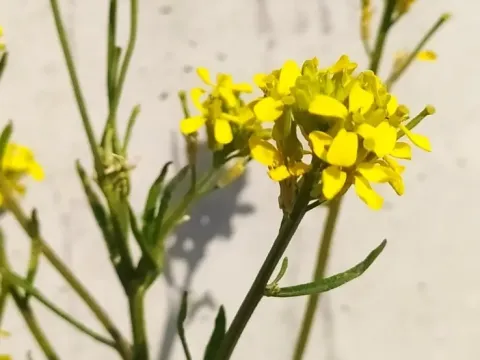
Marschall's Wallflower
Erysimum marschallianum
Marschall's wallflower, belonging to the Brassicaceae family, is a perennial or biennial herb. Proper establishment of the crop is crucial for yield, and seeds should be sown in early spring or late autumn.
What the section contains
Marschall's Wallflower
The optimal temperature for seed germination ranges between 10 and 15 degrees Celsius. Seeds are small, so they require a finely prepared seedbed to ensure uniform emergence.
Planting depth should be kept to a minimum, ideally around 0.5 centimeters, to allow sufficient light for germination while preventing the seeds from drying out.
Spring sowing is common in temperate climates, while late autumn sowing helps in early establishment, taking advantage of soil moisture during the transition period.
Row spacing should be maintained to allow for mechanical weeding and proper air circulation, which significantly reduces the risk of fungal diseases.
This crop thrives in sunny locations with high light intensity, as this is critical for the synthesis of secondary metabolites used in medicine.
Well-drained soils are essential. Marschall's wallflower is sensitive to waterlogging, which often leads to root damage and poor growth performance.
It prefers alkaline to neutral soil conditions. Soil analysis before planting is recommended to ensure that pH levels are within the range of 6.5 to 7.5.
The plant is highly drought-tolerant once established, making it suitable for regions with limited rainfall. However, consistent moisture during the early growth stage is beneficial.
Nutrient requirements are modest. Excessive nitrogen fertilization can lead to vigorous leaf growth but may decrease the concentration of active medicinal compounds.
Fungal diseases, particularly downy mildew and root rot, are the most significant threats during periods of high humidity or poor soil drainage.
Pests such as flea beetles are known to attack young seedlings. Integrated pest management strategies should be employed to protect the crop during its vulnerable stages.
Crop rotation is vital. Avoiding planting Erysimum in fields previously used for other Brassicaceae prevents the build-up of soil-borne pathogens.
Regular monitoring of field conditions allows for early detection of potential outbreaks, enabling timely intervention with organic or approved control methods.
Good field hygiene, including the removal of crop residues and weeds, helps maintain a healthy environment for the plants to mature properly.
Harvesting takes place at the peak of the flowering stage, which is when the plant displays its highest concentration of biologically active cardiac glycosides.
The aerial parts are harvested by cutting the stems, leaving a small portion of the base to potentially allow for future growth or regrowth in perennial varieties.
Drying must be conducted in well-ventilated, shaded areas or industrial dryers at low temperatures to ensure the preservation of heat-sensitive chemical compounds.
The final product must be thoroughly dried and stored in breathable containers to prevent moisture accumulation, which can cause molding or degradation of quality.
Standard yield expectations depend heavily on site conditions, but successful management can result in a high-quality pharmaceutical grade raw material output.