
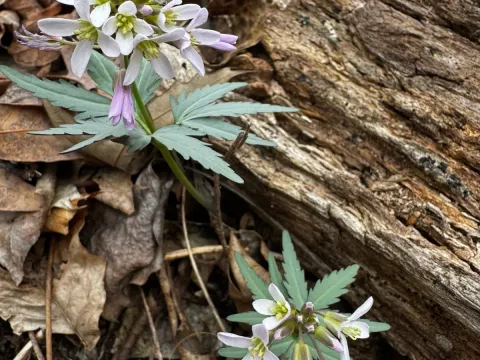
Cutleaf toothwort
Cardamine concatenata
Cutleaf toothwort (Cardamine concatenata) is a perennial herbaceous plant belonging to the Brassicaceae family. It is widely recognized for its unique, bead-like rhizomes, which allow the plant to spread effectively in woodland environments.
What the section contains
Cutleaf toothwort
Native to North America, this plant thrives in deciduous forest settings. It requires humus-rich, moist, and well-drained soils to maintain its vigor throughout the short spring growing season.
In terms of climate requirements, the species prefers temperate regions with cooling spring temperatures. It is highly adapted to understory conditions where dappled sunlight prevents excessive soil heat and moisture loss.
Agricultural or garden management focuses on soil maintenance. Incorporating leaf mold or well-rotted compost provides the necessary nutrients and texture to simulate the plant's natural forest floor habitat.
Once established, the plant is relatively low-maintenance. It enters a dormant state after the forest canopy fully leafs out, which is a key biological feature to consider when planning companion plantings or site rotations.
Crucifer flea beetles are the most significant insect threats to Cardamine concatenata, as they feed aggressively on the young foliage during the early spring period, often leading to stunted growth.
Fungal issues, such as downy mildew or various leaf spots, may occur if the planting density is too high, preventing adequate air circulation. Keeping the foliage dry is a primary preventive measure.
Gastropods, particularly slugs and snails, find the succulent leaves of the toothwort highly palatable. Manual removal or the use of eco-friendly biological baits can manage these populations effectively.
Root health is crucial for the perennial survival of the rhizomes. Overwatering or poor drainage can lead to bacterial or fungal root rots, which are often fatal to the plant during its dormant stage.
Vigilant inspection of the planting site, especially during the early leaf-emergence phase, allows for early detection and mitigation of damage caused by pests or pathogens specific to the Brassicaceae family.