
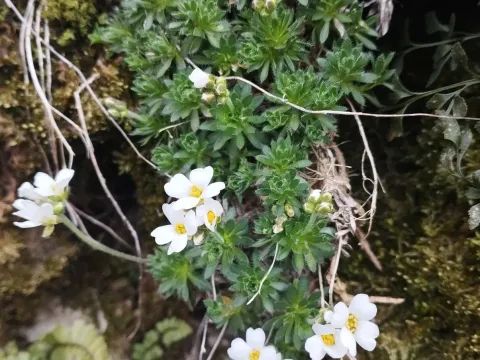
Dede's Whitlow-grass
Draba dedeana
Dede's Whitlow-grass (Draba dedeana) is a perennial herbaceous plant belonging to the Brassicaceae family. Native to the limestone crags and rocky screes of the Pyrenees, it is a specialized lithophyte adapted to harsh, nutrient-poor alpine environments.
What the section contains
Dede's Whitlow-grass
The plant grows in dense, compact, cushion-like mats. Its leaves form small rosettes and are typically covered in fine hairs, an adaptation to preserve moisture and protect the plant tissue from intense UV light and wind exposure found at high altitudes.
Cultivation requires strict adherence to soil conditions: the substrate must be mineral-rich, poor in organic matter, and feature excellent drainage. It is essential to include limestone grit in the potting mix, as this species is a calcicole and thrives specifically in alkaline, calcareous soils.
In terms of climate, it demands full exposure to direct sunlight. While highly frost-tolerant, the primary concern in cultivation is winter survival; it requires protection from prolonged moisture and freeze-thaw cycles that can cause crown rot. A mulch of gravel or grit around the collar is standard practice.
The primary use of Draba dedeana is in specialized rock gardens, scree beds, and alpine troughs. It is prized by alpine plant enthusiasts for its early spring bloom and tidy, evergreen habit, making it an ideal choice for high-maintenance rockery displays.
The most significant threat to Dede's Whitlow-grass is root rot, induced by waterlogged soil or humidity. Ensuring perfect drainage and providing good air circulation around the plants are critical steps for preventing fungal pathogens from compromising the delicate rosettes.
Pest issues are generally minimal, but flea beetles can occasionally damage the leaves during the initial growth phase in spring. Additionally, aphids may target the succulent growth during warm, dry spells, necessitating careful monitoring and prompt manual or mechanical control.