
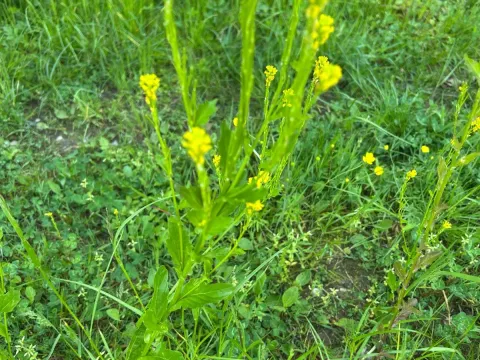
Strict wintercress
Barbarea stricta
Strict wintercress is primarily a biennial or winter annual plant. Seeds typically germinate in the autumn, forming a basal rosette of leaves during the first year of life that successfully overwinters under a layer of snow.
What the section contains
Strict wintercress
Spring development begins when daily average temperatures reach approximately +5 to +7 degrees Celsius. Mass emergence of seedlings from seeds shed in the previous season is frequently observed in late August or September.
When cultivated as a honey plant or green manure crop, it is recommended to sow with a seeding rate of about 10–12 kg per hectare. Seeds should be sown at a depth of no more than 1.5–2 cm to ensure optimal contact with the soil.
The plant possesses high germination energy, allowing it to compete with other crops during early development stages. In intensive farming systems, strict wintercress requires monitoring, as it can rapidly colonize available areas.
The optimal period for forming a robust leaf rosette before the onset of persistent frost is a duration that provides the plant with at least 40–50 days of active vegetation after seed germination.
Strict wintercress belongs to the Brassicaceae family and prefers sufficiently moist soils. It thrives in loamy and clayey substrates and is often found in floodplain meadows and along the banks of water bodies.
The crop has moderate climate requirements, exhibiting high winter hardiness. It is capable of withstanding significant temperature fluctuations, which allows it to extend its range into northern regions.
The plant is photophilous (light-loving), so the best growth indicators are observed in open, well-lit areas. Shading leads to stem elongation and a significant decrease in the overall productivity of the green mass.
Soil acidity levels for strict wintercress should range from pH 5.5 to 7.0. While moisture-loving, it does not tolerate prolonged waterlogging and requires good drainage for the normal development of its root system.
For intensive growth, the plant requires sufficient nitrogen and phosphorus content in the soil. The application of mineral fertilizers during the early stages of spring vegetation significantly increases biomass yield and seed material quality.
The economic value of strict wintercress lies in its use as an early spring honey plant. It provides bees with nectar and pollen during a period when most other crops have not yet begun active flowering.
In animal husbandry, strict wintercress is valued as a source of early green fodder; however, the presence of specific glycosides in the plant must be taken into account. Before feeding in large volumes, wilting or ensiling the mass is recommended.
Green mass yield can reach 150–200 centners per hectare when optimal nutrition and moisture levels are maintained. Indicators depend on the timing of harvesting, which should be conducted before the stems become fully lignified.
The plant's seed productivity is very high: one strong plant can produce thousands of tiny seeds. This trait makes it highly persistent in natural phytocenoses but requires careful management when used in crop rotations.
Using strict wintercress as a green manure crop allows for the improvement of soil structure, enrichment with organic matter, and the suppression of many soil-borne pathogens due to the plant's phytocidal properties.
The primary pests of strict wintercress are representatives of the flea beetle family, which attack young leaves during the rosette stage. A massive infestation can destroy crops in a very short time.
Significant damage is also caused by the blossom beetle, which feeds on buds and hinders normal flowering. Combating this pest requires the application of insecticides during the budding stage.
Among diseases, clubroot is the most dangerous, causing the formation of galls on roots and stunted growth. Powdery mildew and downy mildew are also possible during periods of high air humidity.
To control pest populations, it is recommended to use biological preparations or maintain spatial isolation from other brassica crops. Proper crop rotation is an essential agricultural practice to minimize risks.
Chemical protection should be used strictly according to economic threshold indications to avoid negative impacts on honeybee populations and natural predators that keep pest numbers in check.
Harvesting for green mass is carried out at the beginning of flowering when the plant contains the maximum amount of nutrients. During this period, the stems remain juicy and have not yet accumulated an excess of fiber.
For seed production, harvesting is carried out when the lower pods ripen and turn a yellowish-brown color. It is critical to perform operations before pod dehiscence and seed shedding, which requires a timely approach.
Mechanized harvesting requires the use of combines with proper adjustment of the cutting unit and cleaning system. Thorough drying of the harvested bulk is necessary to prevent spontaneous combustion and spoilage of seed material.
After harvesting for seeds, a large amount of plant residue remains in the fields, which can be utilized as green manure. Incorporating these residues into the soil helps build up humus in the topsoil layer.
It is recommended to clean the seed material immediately after harvest to remove weed impurities. Storage should take place in dry, well-ventilated facilities with a moisture content of no more than 12–14 percent.