
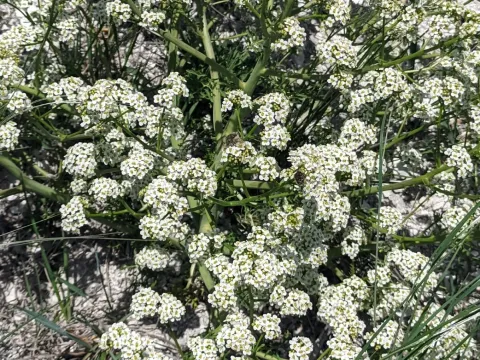
Tartar sea-kale
Crambe tataria
Tartar sea-kale (Crambe tataria) is a perennial herbaceous plant belonging to the Brassicaceae family. Due to the hard seed coat, successful germination typically requires pre-sowing treatments like scarification or prolonged cold stratification for several months to break dormancy.
What the section contains
Tartar sea-kale
Sowing is usually performed in late autumn or early spring, as soon as soil conditions permit fieldwork. Seeds are planted at a shallow depth of 2-3 centimeters, ensuring adequate contact with the soil to promote moisture absorption and stable germination.
Maintaining high soil moisture during the emergence stage is critical, as seedlings are sensitive to surface desiccation. Row spacing should be kept between 45 and 60 centimeters, allowing sufficient room for plant development and mechanical cultivation tasks.
Seedlings emerge relatively slowly, making it vital to keep the field free from weeds to prevent competition for sunlight and nutrients. Thinning is essential once the plants develop two or three true leaves to establish optimal spacing between individual plants.
Providing sufficient spacing allows the plants to establish a strong rosette, which helps the crop effectively shade out competing vegetation later in the growing season.
This crop is highly light-demanding and thrives in open, sunny locations. It is exceptionally resilient, demonstrating significant drought tolerance and hardiness, allowing it to adapt to various climatic conditions including regions with challenging weather patterns.
Crambe tataria prefers deep, well-drained, fertile loamy or sandy soils with a neutral or slightly alkaline pH. It performs poorly in acidic or waterlogged environments, which frequently trigger root rot and other fatal physiological issues.
Deep soil tillage and regular inter-row cultivation are fundamental to success, as they improve soil aeration and water management. Maintaining a loose soil structure is crucial for the development of healthy, long taproots characteristic of this species.
Fertilization strategies should focus on phosphorus and potassium to strengthen root development, whereas excessive nitrogen may promote unwanted foliage growth at the expense of root quality. Organic matter should ideally be incorporated during pre-planting soil preparation.
Proper field rotation is necessary to maintain soil health and prevent the buildup of soil-borne pathogens, ensuring that the crop can reach its full potential over several years of growth.
The yield of Tartar sea-kale is primarily focused on its fleshy roots, which typically reach commercial maturity by the second or third year of growth. The size and overall biomass of the roots increase significantly over time with proper crop management.
Intensive farming techniques, including drip irrigation in arid regions, can substantially boost root productivity. The quality and composition of the roots, rich in glycosides and sugars, depend on environmental conditions and harvest timing.
Aside from its utility as a root vegetable, the crop also produces viable seeds, enabling farmers to maintain their own seed stocks. Collecting seeds as they mature requires careful monitoring to prevent premature shattering from the pods.
By implementing balanced fertilization and weed control programs, growers can ensure consistent yields that meet industrial or culinary market standards. Yield stability is a hallmark of this hardy perennial species under managed agricultural conditions.
Sustainability of the crop depends on careful soil stewardship and avoiding over-harvesting, which allows the plant populations to remain productive across multiple growing cycles.
Clubroot is a major threat to Crambe tataria, as it severely damages the root system and can lead to complete crop loss. Preventing this disease requires strict adherence to crop rotation cycles and maintaining proper soil pH levels to discourage pathogen growth.
Crucifer flea beetles are the most dangerous pests during the seedling stage, often causing rapid defoliation that can destroy entire plots. Timely application of insecticides or the use of protective netting is often required for effective control.
Powdery mildew and other fungal pathogens may appear under high humidity and poor ventilation conditions. Routine monitoring and prophylactic fungicide treatments help manage disease pressure and maintain the plant's photosynthetic capacity.
Larvae of cabbage white butterflies and other defoliating insects can weaken the plants, leading to reduced root weight. Biological control agents are often preferred to manage these pests while minimizing ecological impact.
Maintaining clean farming practices, including the removal of crop residues and spatial isolation from other Brassicaceae species, is essential to minimize the risk of pest and disease outbreaks.
Harvesting Tartar sea-kale is a labor-intensive operation that necessitates specialized machinery to reach the deep-seated roots without excessive damage. Late autumn is the preferred time for harvest, as the plant reserves are fully developed.
Before digging, the foliage is mowed, leaving short stalks for easier processing and collection. Care must be taken during the digging process to preserve the integrity of the roots, as broken surfaces are prone to post-harvest decay.
Once harvested, the roots are cleaned of soil and sorted by size and quality. Removing diseased or injured roots is critical for ensuring that the rest of the batch stays in good condition during the storage phase.
Roots should be stored in cool, humid environments, often buried in sand to prevent dehydration and maintain freshness. This storage method allows the produce to remain marketable for several months after the harvest season.
After processing, the harvested roots serve as a high-value culinary product or an industrial raw material, offering versatile options for market entry and value-added agricultural production.