
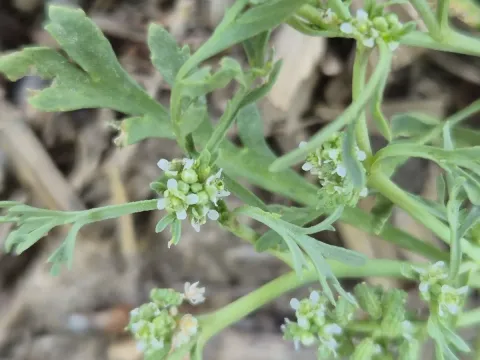
Swinecress
Lepidium coronopus
Swinecress, scientifically known as Lepidium coronopus, is a member of the Brassicaceae family. While often considered a weed in some regions, it has historical use as a culinary herb and is studied for its rapid growth cycle.
What the section contains
Swinecress
Sowing typically takes place in early spring once the danger of hard frost has passed. Seeds should be sown in rows spaced 20 to 30 centimeters apart to allow for proper airflow and root development.
The seeds are relatively small and should be planted at a shallow depth of approximately 1 centimeter. A firm seedbed is essential to ensure adequate soil-to-seed contact and consistent germination across the plot.
For cultivation purposes, managing sowing density is crucial. Over-seeding leads to competition for nutrients and increased humidity, which may promote the development of fungal diseases among the young plants.
Successional planting can be employed throughout the spring and early summer if the goal is a continuous supply of fresh foliage, provided that water availability remains sufficient during the hotter months.
The crop thrives in sunny, open locations with well-drained, nutrient-rich soils. It prefers loam or sandy loam substrates that do not retain excess water, as waterlogged conditions inhibit its growth.
Although it can tolerate various pH levels, a near-neutral to slightly alkaline soil environment is optimal. Proper soil preparation, including light tilling, is recommended before sowing to ensure optimal root penetration.
Temperature requirements are moderate; the plant grows best in cool to mild climates. In regions with extremely high temperatures, the plant may initiate bolting prematurely, which reduces the quality of the harvestable leaves.
Moisture management is key. While the plant is somewhat drought-tolerant once established, regular irrigation during dry spells promotes tender growth and prevents the foliage from becoming overly tough or bitter.
Minimal fertilization is usually sufficient, as the plant is efficient at extracting nutrients. However, an application of compost or well-balanced mineral fertilizer at the beginning of the season can boost biomass production.
The most common pests associated with Lepidium coronopus are flea beetles. These insects create small holes in the foliage, significantly reducing the market value and health of the plant.
Larvae of the cabbage white butterfly can also cause significant damage by defoliating the crop. Implementing physical barriers, such as floating row covers, is often the most effective method for smaller production areas.
Fungal issues, including powdery mildew and white rust, can appear if the plants are grown in areas with poor circulation or consistently high humidity. Maintaining healthy spacing and removing weeds is vital for prevention.
Root diseases, such as clubroot, can occur in fields where Brassicaceae crops have been grown too frequently. Strict adherence to a diverse crop rotation cycle is necessary to break the pest and disease life cycles.
- Flea beetles.
- Cabbage white butterflies.
- Powdery mildew.
- Clubroot.
- Aphids.