
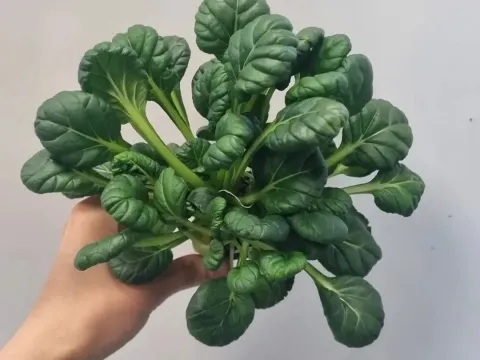
Tatsoi
Brassica narinosa
Tatsoi is a fast-growing, cool-season crop that can be seeded directly into the soil or started in trays. The best time for sowing is early spring as soon as the soil warms up to 5-10 degrees Celsius, or late summer for an autumn harvest.
What the section contains
Tatsoi
Seeds are sown at a depth of 1-1.5 centimeters with spacing of 20-30 centimeters between rows. The plant matures rapidly, allowing for successive sowings every 3 weeks to ensure a continuous supply of fresh greens throughout the season.
When starting indoors, seedlings are ready for transplanting within 20-25 days. Tatsoi tolerates transplanting well if the root ball remains intact, which provides a head start on the harvest by one or two weeks.
It is important to note that long daylight hours trigger bolting. Therefore, successful cultivation is most easily achieved during the shorter days of spring and autumn to maintain vegetative growth.
Crowded plantings should be thinned to allow each plant to form its characteristic rosette shape. An optimal spacing of 20-25 centimeters between plants is recommended for the best development of the broad, spoon-shaped leaves.
Tatsoi belongs to the Brassicaceae family and is closely related to bok choy. It is a highly frost-tolerant crop capable of withstanding light freezes down to minus 5-7 degrees Celsius, making it an excellent choice for northern climates.
For vigorous growth, the crop requires fertile, moisture-retentive loamy or sandy soils with a neutral to slightly acidic pH. Lime application may be necessary on acidic soils to promote steady development and overall plant health.
The plant has high water requirements. Drying out of the substrate leads to leaf toughening and premature flowering, so consistent irrigation is essential to ensure a tender and succulent product quality.
Tatsoi thrives in full sun, but some light shade during intense summer heat helps maintain the quality of the foliage. It requires adequate nitrogen fertilization during the early stages of rosette development for optimal biomass production.
It is recommended to include tatsoi in a crop rotation program following tomatoes, legumes, or potatoes. Avoiding planting in soil previously used for other brassicas prevents the buildup of specific soil-borne pathogens and pests.
Yield potential depends heavily on light intensity, plant density, and soil fertility. On average, gardeners and farmers can expect a yield of 1.5 to 3 kilograms of fresh leafy mass per square meter.
Using intensive greenhouse production methods with supplemental lighting can significantly increase these yields. The compact rosette growth habit allows for high-density planting, maximizing the use of available garden space.
Varietal selection plays a crucial role in yield outcomes. Modern hybrids are bred for uniformity and the ability to maintain a compact, high-quality rosette without becoming leggy as the season progresses.
Regular applications of balanced fertilizers during the growing cycle contribute significantly to the individual weight of the plants. A well-developed mature tatsoi rosette can reach 200 to 400 grams.
Yield also depends on the harvesting technique. While individual leaves can be picked for a prolonged harvest, the most common commercial practice is the single-cut harvest of the entire rosette for market distribution.
Tatsoi is prone to standard brassica pests, with the flea beetle being the most damaging threat. These insects can devastate young seedlings in a matter of days by creating numerous small holes in the tender leaves.
Cabbage worms and loopers are also significant threats. They feed aggressively on the leaf tissues, which significantly reduces market value and creates entry points for various secondary fungal and bacterial infections.
Clubroot is considered one of the most severe diseases affecting the root system. Furthermore, high humidity and poor air circulation can lead to outbreaks of powdery mildew, downy mildew, and various bacterial rots.
Integrated pest management, including both biological and chemical controls, is used according to safety regulations. Covering crops with fine horticultural fleece during the initial growth stages provides an effective barrier against flying insect pests.
- Flea beetles
- Cabbage worms
- Clubroot
- Downy mildew
- Slugs
Tatsoi matures very quickly, reaching technical harvest maturity within 40-50 days after emergence. A fully developed, dense, and firm rosette indicates that the plant is ready for harvesting.
Harvesting is best performed during the cool morning hours when leaf moisture content is highest, which allows the greens to maintain their freshness and turgor for longer periods post-harvest.
After cutting, the rosettes are cleaned of any damaged or old lower leaves. The product is then either washed or immediately placed in cold storage to preserve quality. Avoiding over-maturation is vital to prevent bitterness.
For transportation, the produce should be packed in perforated containers to ensure adequate airflow and prevent internal heating. Like many leafy greens, tatsoi is sensitive to high temperatures after the harvest.
When stored in a refrigerator at 1-3 degrees Celsius with high humidity, fresh tatsoi can maintain its quality for 7-10 days. The leaves are versatile, suitable for both fresh consumption and various quick culinary preparations.