
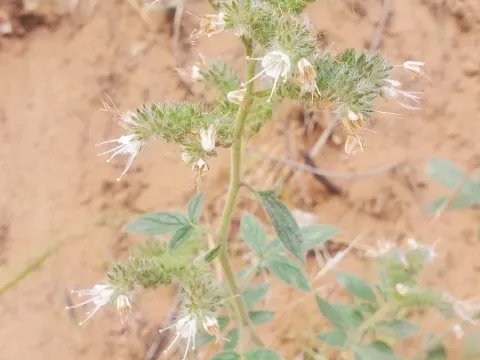
Phacelia heterophylla
Phacelia heterophylla
Phacelia heterophylla is a member of the Boraginaceae family. In agricultural practice, sowing is carried out in early spring as soon as the soil warms up to 5-8 degrees Celsius, which ensures optimal germination and uniform emergence of seedlings.
What the section contains
Phacelia heterophylla
To obtain green manure or a continuous nectar flow, sowing can be staggered in several stages with an interval of 2-3 weeks. This allows for an extended flowering period and provides a stable food base for pollinators throughout the season.
The recommended seeding rate is 8-10 kg per hectare using standard row seeding methods. The seeding depth should not exceed 1-2 cm, as the seeds are small and sensitive to the density of the topsoil layer.
The crop is characterized by rapid initial growth, which allows it to effectively compete with weeds during the early stages of vegetation. Seedlings typically appear within 10-14 days after sowing if sufficient soil moisture is available.
Soil preparation begins with autumn plowing and spring harrowing. The surface of the field should be leveled to ensure even distribution of seeds and to prevent the soil from drying out excessively.
This phacelia species is an undemanding plant, adapted to various soil types including loams and sandy soils. However, it achieves the best results in fertile, well-aerated soils with a neutral pH reaction.
The plant demonstrates high drought tolerance, making it suitable for cultivation in regions with unstable rainfall patterns. Nevertheless, for maximum vegetative biomass, the availability of moisture during the active growth phase is critical.
Phacelia heterophylla is not very demanding regarding light, although the most abundant flowering is observed in open, well-lit areas. The plant is capable of withstanding light frosts, which provides an advantage for early sowing dates.
The application of mineral fertilizers, especially phosphorus-potassium types, has a beneficial effect on nectar quality and total biomass mass. High doses of nitrogen can lead to lodging of the stems, so their use should be moderate.
A weed control system is almost unnecessary with proper sowing. Due to the rapid closing of the rows, phacelia itself suppresses the development of weeds, effectively acting as a biological herbicide.
The yield of green biomass of Phacelia heterophylla varies depending on the agricultural background and weather conditions of the season. On average, one can expect to obtain 150-250 centners of green mass per hectare of crops.
As a honey plant, the crop possesses enormous potential, providing up to 200-300 kg of honey per hectare. The phacelia nectar is distinguished by its high sugar content and excellent taste qualities.
When used as a cover crop, the volume of organic matter returned to the soil is comparable to applying significant doses of manure. This significantly improves soil structure, increasing its water-holding capacity and biological activity.
The seed productivity of the crop is also at a high level. With proper agronomic techniques, farmers obtain a stable seed harvest, which is suitable for renewing plantings in subsequent years.
The stability of the yield depends on the intensity of insect pollinator activity. Since phacelia actively attracts bees and bumblebees, this contributes not only to obtaining high-quality honey but also to better seed set.
The crop is characterized by high phytosanitary stability, making it attractive for organic farming. Major diseases, such as powdery mildew or gray mold, are extremely rare.
Among pests, only episodic aphid infestations in years with excessively hot and dry summers can be noted. In such cases, chemical treatment is usually not carried out due to potential harm to pollinators.
The risk of damage by wireworms or other soil pests is minimal, as phacelia possesses specific root exudates. This allows it to be used in crop rotation for soil health improvement.
It is important to monitor for waterlogging, as stagnant water can lead to the development of root rots. Proper drainage on the plot is the key to plant health throughout the growing season.
In general, Phacelia heterophylla is considered one of the cleanest crops, requiring no pesticide application. This makes it an ideal component for ecological farming operations.
Harvesting for green manure is conducted in the mass flowering phase, when the accumulation of organic matter reaches its peak. At this point, the biomass is most succulent and easily decomposes in the soil.
For seed harvesting, the process is carried out when 70-80% of the seed pods have matured. It is important to avoid delaying the harvest, as the seeds are prone to shattering under strong winds or mechanical impact.
The mowing method involves the use of shredders or mowers, followed by incorporation into the topsoil layer using disc harrows. This ensures rapid transformation of the mass into humus.
When collecting seeds, it is advisable to use a combine harvester followed by drying at a storage facility. Phacelia seeds are sensitive to storage conditions, so humidity in warehouses should not exceed 12-14%.
A properly organized harvest allows for the efficient use of crop residues to improve field fertility. The entire cycle from sowing to incorporation usually takes between 60 and 80 days.