
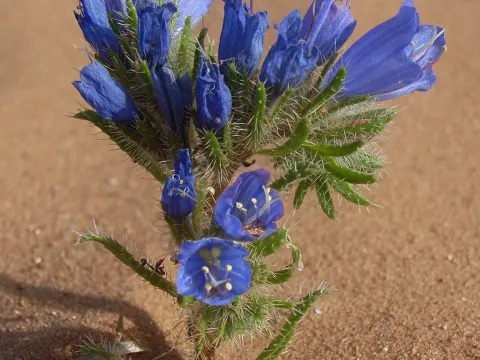
Echium trygorrhizum
Echium trygorrhizum
Echium trygorrhizum, a member of the Boraginaceae family, is a highly valued nectariferous crop. Sowing is typically carried out in early spring as soon as the soil warms up to 8–10 degrees Celsius, facilitating rapid and uniform germination.
What the section contains
Echium trygorrhizum
Seeds should be sown at a shallow depth of 2–3 centimeters in well-prepared, firm soil. Achieving good soil contact is crucial for the germination process, especially in regions with volatile spring weather conditions.
The seeding rate ranges between 3 and 4 kilograms per hectare when using row-drilling methods. Proper spacing ensures that each plant has enough room to develop a strong, deep taproot, which is essential for its survival and productivity.
Winter sowing is also an option in specific temperate climates. This strategy allows the plants to take early advantage of spring moisture, leading to faster development and a more prolonged flowering phase later in the season.
Since the plant grows slowly in its initial stages, weed control is a critical management task. Regular inter-row cultivation during the early weeks of the vegetative period prevents competition and promotes healthy development of the crop.
Echium trygorrhizum requires full sun exposure to thrive. Shade significantly reduces the plant's metabolic activity, leading to weaker stems and a dramatic drop in nectar production, which is the primary value of the crop.
The plant is highly adaptable to poor-quality soils, including sandy, rocky, or saline environments where other agricultural crops struggle to survive. Its deep root system allows it to efficiently extract nutrients and water from deep soil layers.
Poorly drained or waterlogged soils are strictly unsuitable for this crop. It prefers neutral to slightly alkaline soil reactions and requires adequate aeration to prevent root rot, especially during cooler or wetter spring months.
Climate-wise, the plant is remarkably hardy and capable of surviving extreme temperature fluctuations. Its cold resistance makes it an excellent choice for regions with continental climates that experience harsh, variable winter conditions.
This crop is also recognized for its soil-improving properties. By anchoring deep into the substrate, the plants help stabilize the soil, minimize erosion on slopes, and enhance the overall structure of the ground for subsequent seasons.
The primary economic purpose of Echium trygorrhizum is as a premium honey plant. It is renowned for its ability to produce high quantities of nectar even during intense drought, providing a critical resource for beekeepers when other sources fail.
Honey yields can reach 300–600 kilograms per hectare under optimal conditions. The resulting honey is typically light in color, possesses a delicate floral aroma, and has a slow crystallization rate, making it highly desirable on the market.
In addition to nectar, the plant provides a substantial amount of biomass that can be utilized for green manure. It enriches the soil with organic matter and minerals, which is beneficial for restoring productivity to degraded lands.
Seed production is another vital aspect of the crop's utility. A yield of 3–5 quintals per hectare is achievable with proper care, ensuring that farms can maintain their own seed bank for future cycles without the need for external purchasing.
The forage value for pollinators is unmatched. By planting this crop, farmers contribute significantly to local ecosystem health, supporting bees and other beneficial insects that improve the pollination of surrounding agricultural fields.
Echium trygorrhizum generally exhibits high resistance to standard crop diseases. However, excessive soil humidity can trigger powdery mildew or root rot infections, making site selection and water management the top priorities for an agronomist.
Insect pests, such as weevils, may cause damage during the budding phase. Regular monitoring of the field is necessary to identify early signs of infestation and determine if targeted intervention is required to protect the yield.
Late spring frosts can be hazardous if they coincide with the sensitive cotyledon stage. While the plant is inherently resilient, abrupt temperature drops can cause stress, resulting in stunted growth or uneven stand establishment.
Continuous cropping without rotation can lead to the build-up of host-specific pathogens within the soil. Adhering to a diversified crop rotation plan is essential to mitigate these risks and ensure the long-term sustainability of the field.
Chemical plant protection products must not be applied during the flowering stage, as this poses a fatal threat to bees and pollinators. All pest management activities should be completed well before the first flowers open.
Harvesting Echium trygorrhizum seeds requires precision due to their tendency to shatter. The process begins when the lower parts of the inflorescences turn dark brown, indicating that the seeds have reached physiological maturity.
The two-stage harvesting method is the industry standard. Plants are mowed and windrowed to allow for uniform drying, after which they are threshed. This method reduces harvest losses and ensures higher quality of the collected seed.
The operation is best performed during the early morning or late evening hours. Increased ambient humidity at these times helps prevent excessive shattering and loss of seed during the mechanical cutting and gathering process.
Post-harvest cleaning is necessary to remove plant debris and foreign material. The seeds must then be dried to a moisture content of 12–14%, which is the standard safety threshold for long-term storage and viability.
Stored seeds should be kept in cool, dry, and well-ventilated facilities. Regular inspections are advised to monitor for moisture levels, ensuring the seeds remain free from mold and maintain their germination potential for the following season.