
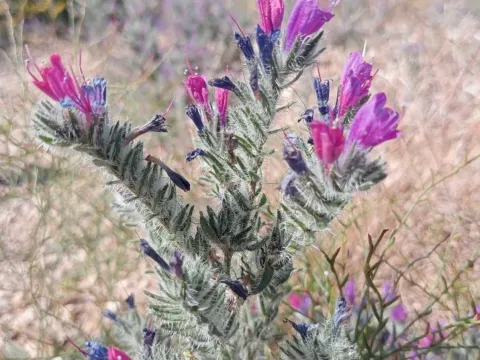
Echium humile
Echium humile
Echium humile is a herbaceous plant belonging to the Boraginaceae family, recognized for its adaptability to dry environments and its significant role as a nectar-producing crop.
What the section contains
Echium humile
The sowing season typically ranges from late winter to early spring, depending on the climatic zone, to ensure that seeds germinate before the intense summer heat arrives.
Seeds should be sown at a shallow depth of 1 to 2 cm, ensuring adequate seed-to-soil contact, which is crucial for the germination process in sandy or rocky soil conditions.
In field production, spacing is critical; rows are typically spaced between 30 and 50 cm apart to allow for proper airflow and to simplify mechanical weed management during the establishment phase.
Success in sowing relies heavily on a clean, weed-free seedbed, as the early development of Echium humile can be relatively slow, making it vulnerable to competition from aggressive weeds.
Echium humile thrives in regions with high solar radiation and is particularly well-adapted to Mediterranean or arid climates where other crops might fail due to lack of moisture.
The ideal soil profile for this species consists of well-drained, sandy, or stony textures, and it performs best in neutral to slightly alkaline pH levels, reflecting its natural habitat.
Water requirements are relatively low once the plant has established a deep taproot, making it an excellent candidate for low-input agricultural systems and xeriscaping projects.
Proper drainage is the most vital agronomic factor; the species is highly susceptible to root rot if exposed to waterlogging or poorly drained clay soils during the dormant or growth seasons.
Farmers should prioritize sunny locations for cultivation, as shade or high canopy density significantly reduces the plant's photosynthetic efficiency and overall biomass production.
Diseases in Echium humile are primarily linked to fungal pathogens that proliferate under high humidity conditions, often leading to issues like powdery mildew or stem blight.
Insect pests such as leaf-eating beetles and certain species of aphids are known to target the foliage, potentially stunting growth if infestations occur early in the spring season.
Poor ventilation within the crop canopy acts as the main driver for pathogen spread, necessitating proper row spacing and weed management to maintain healthy air movement around the plants.
Crop protection strategies should favor biological controls or early detection of pest populations to minimize chemical interventions, which helps maintain the plant's value as a nectar source.
Effective management includes maintaining a robust crop rotation plan, ensuring that the field is not repeatedly used for Boraginaceae members, thereby reducing the buildup of host-specific pathogens.