
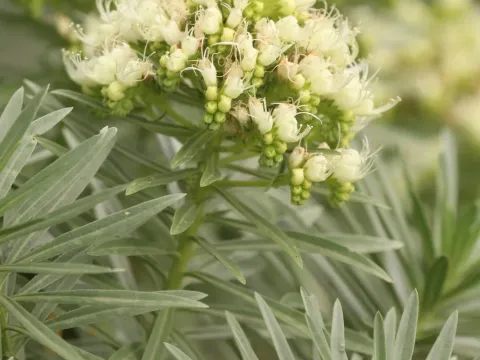
Echium leucophaeum
Echium leucophaeum
Echium leucophaeum requires warm soil conditions for successful germination, making late spring the ideal time for sowing once the danger of frost has passed.
What the section contains
Echium leucophaeum
Due to the small size of the seeds, they should be sown shallowly, ideally at a depth of no more than 1–2 centimeters, to ensure they do not exhaust their energy before reaching the surface.
Sowing in rows with adequate spacing is recommended to reduce competition for light and nutrients, allowing the plants to establish a strong rosette during the first season.
Light rolling of the soil after planting is essential to create firm contact between the seeds and the soil particles, which significantly improves moisture absorption.
Maintaining a weed-free environment during the initial growth stage is crucial, as the seedlings are delicate and can be easily outcompeted by aggressive weeds.
This species, belonging to the Boraginaceae family, is highly drought-tolerant and thrives in well-drained, sandy, or rocky soils that mimic its native Canary Islands habitat.
It prefers full sun exposure and is sensitive to waterlogged conditions, which can lead to rapid root rot and overall plant decline in poorly drained areas.
The plant performs best in neutral to slightly alkaline soil conditions and does not require heavy fertilization, as it is adapted to nutrient-poor environments.
Excessive moisture, particularly during the dormant season, should be strictly avoided to maintain the plant's long-term health and structural integrity.
While adapted to harsh environments, providing consistent, moderate irrigation during the early development phase can help establish deeper root systems.
Echium leucophaeum is primarily recognized for its significant nectar-producing capacity, making it a highly valuable crop for honey production.
The total yield of nectar is dependent on optimal plant density and environmental factors that favor consistent blooming throughout the flowering season.
Beyond beekeeping, the species can be utilized in land restoration projects, as its robust root system helps stabilize loose soil and prevents erosion in hilly terrain.
Seed yield can be substantial, although careful management is required to prevent pre-harvest loss caused by the natural shattering of mature seeds.
As an agricultural crop, its value lies in its low input requirements and ability to provide ecological services while maintaining soil stability.
Fungal diseases, specifically root and crown rots, represent the most significant threat to this species, usually resulting from excessive soil moisture or poor drainage.
Insect pests like leaf-eating beetles and weevils may target the foliage or floral buds, necessitating integrated pest management strategies that avoid harmful chemical residues.
Competition from invasive weeds can drastically reduce the health of a stand, particularly during the first year when plants are developing their root systems.
Pollinator health is a top priority, so any necessary pest control must be timed carefully to occur outside of peak flowering hours to minimize impact.
Proper field rotation and the use of clean, certified seeds are the most effective preventive measures against the build-up of soil-borne pathogens.
Harvesting should be performed when the seeds reach physiological maturity, indicated by a darkening of the floral spikes to a deep brown or grey color.
A two-stage harvesting approach, involving swathing and subsequent threshing, is recommended to capture the seeds before they naturally shatter on the field.
After threshing, the seed mass must be cleaned to remove chaff and organic debris, which helps prevent potential moisture accumulation and spoilage in storage.
Drying the seeds in a well-ventilated area away from direct sunlight is essential to achieve a moisture content of approximately 12–14 percent for safe storage.
Long-term storage should be in a cool, dry place using breathable containers to maintain high germination rates for future planting seasons.