
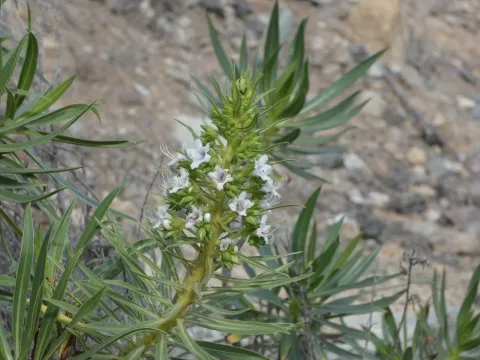
Echium decaisnei
Echium decaisnei
Echium decaisnei, a member of the Boraginaceae family, is a perennial plant that requires specific conditions for successful establishment. The optimal time for sowing in open fields is during the spring months once the soil has warmed sufficiently to approximately 10-12 degrees Celsius.
What the section contains
Echium decaisnei
Due to the long germination period characteristic of this species, pre-sowing stratification is highly recommended to improve uniformity. Seeds should be sown at a shallow depth of 1-2 centimeters to ensure they receive sufficient light and moisture for development.
For commercial production, a sowing pattern with row spacing of 45-60 centimeters is advised. This spacing provides adequate room for the plant to develop its robust taproot system and expansive leaf rosette during the establishment phase.
Sowing can be executed using either standard row seeding or strip-tilling equipment. During the first year, the focus of the plant is vegetative growth, necessitating vigilant weed control to prevent competition for nutrients and space.
Using high-quality, viable seeds is essential for a productive harvest. Seed treatment prior to planting can help mitigate the risk of soil-borne diseases that might affect early seedling development in the field.
Native to the Canary Islands, Echium decaisnei is a highly heliophilic species, meaning it requires full exposure to sunlight for optimal growth. Insufficient light levels will lead to elongated, weak stems and significantly reduced flowering potential.
The plant thrives in well-drained, light-textured soils such as sandy or rocky substrates. It is particularly sensitive to waterlogged conditions, which can lead to root rot and other physiological stressors, making proper drainage a prerequisite.
This species exhibits remarkable drought tolerance, allowing it to flourish in regions with limited rainfall. Its deep taproot system allows it to access subsoil moisture, making it resilient during hot, dry summer periods.
Soil pH should ideally be in the neutral to slightly alkaline range. If soils are highly acidic, lime applications are required prior to planting to create a suitable growing environment for the plant to reach its full development.
While the plant is resistant to high temperatures, it is sensitive to severe spring frosts during active vegetative growth. Selecting locations that offer shelter from prevailing cold winds can significantly improve plant survival rates and overall yield stability.
The primary economic value of Echium decaisnei lies in its exceptional nectar production, making it a prized plant for apiculture. Its flowers provide a rich source of high-quality nectar, attracting pollinators throughout the flowering season.
Honey production per hectare can be quite significant, depending on plant density and local environmental conditions. Honey derived from this species is known for its distinct aroma and excellent texture, with a slow crystallization process.
Beyond its use in beekeeping, the plant can be utilized in landscaping, erosion control, or as a source of biomass. Its ability to thrive in poor soils makes it an ideal candidate for soil stabilization projects in arid environments.
Effective pollination facilitated by managed beehives adjacent to the field is essential to maximize both honey production and seed yield. Collaboration between agricultural producers and beekeepers ensures mutually beneficial outcomes for both industries.
Managing the harvest for seeds requires careful monitoring of the physiological maturity of the seed heads. A strategic approach to timing ensures that the maximum yield of high-quality seeds is recovered while minimizing harvesting losses.
Root rot, often caused by fungal pathogens in overly moist soil conditions, remains the primary threat to Echium decaisnei plantations. Maintaining proper soil moisture and drainage is the most effective preventive measure against such infections.
Pests such as aphids and various weevil species may affect vegetative parts and buds during dry spells. Regular field scouting and the application of integrated pest management strategies are recommended to maintain pest populations below economic injury levels.
Powdery mildew can occur in conditions characterized by high air humidity and poor ventilation within the crop canopy. Ensuring proper spacing and keeping the area clear of weeds facilitates better airflow, which reduces the incidence of this disease.
Balanced fertilization is key, as excessive nitrogen can lead to soft, succulent growth that is more prone to both pest infestations and disease development. Proper nutrition helps strengthen the natural defenses of the plant against common stressors.
If significant disease outbreaks occur, infected plant materials should be removed and destroyed to prevent spreading. Promoting high plant vigor through good agricultural practices is the best insurance against various environmental threats.
The harvest of Echium decaisnei seeds begins when the seed capsules have turned dark brown or black and the stalks have become dry. This phase generally occurs in the late summer, depending on the specific climatic zone of production.
The harvesting process often involves swathing and drying the plant material in windrows, which allows for uniform maturation of the seeds. This technique is effective in mitigating seed losses that might otherwise occur during direct combining.
Threshing is performed with agricultural combines adjusted to low drum speeds to avoid damaging the seed embryos. Precision adjustment of cleaning fans is necessary to ensure that chaff and debris are effectively separated from the seed.
Post-harvest processing involves cleaning and drying the seeds to a moisture level below 12-14 percent for long-term storage. Maintaining these conditions is vital to preserve the high germination potential of the seed stock.
Seeds should be stored in a cool, dry, and dark environment to prevent degradation and mold growth. Proper inventory control and periodic testing of germination rates are recommended to ensure success in future planting seasons.