
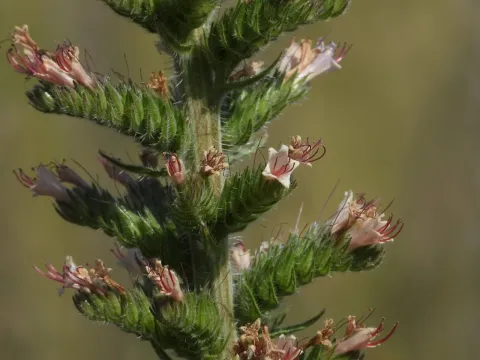
Echium boissieri
Echium boissieri
Echium boissieri is typically a biennial plant, so planting is usually scheduled for early spring or autumn. Seeds require thorough soil preparation, including loosening and surface leveling, to ensure uniform germination across the field.
What the section contains
Echium boissieri
The sowing depth ranges from 1 to 2 centimeters, depending on the soil type and moisture level. Planting is carried out in rows with spacings of up to 45 centimeters, which facilitates effective mechanical weeding and inter-row cultivation during the growing season.
During the first year of vegetation, the culture forms a robust rosette of basal leaves and develops a strong taproot system. This allows the plant to accumulate sufficient nutrients for successful overwintering and subsequent flowering in the second year.
An important requirement is to avoid overcrowding, as the plant is light-loving and requires sufficient space for healthy development. Sowing rates must be balanced to prevent competition between plants within the rows.
To speed up germination in heavy soils, light rolling is recommended to ensure firm contact between the seed and the soil substrate, which facilitates capillary moisture movement to the seeds.
The culture belongs to the Boraginaceae family and shows high adaptability to arid conditions, originating primarily from Mediterranean-type climates. It prefers well-lit, open areas and does not tolerate shading or waterlogging.
Echium boissieri has moderate soil requirements, but peak productivity is achieved on light sandy or loamy soils with a neutral to slightly alkaline reaction. Excessive soil moisture can lead to root neck rot diseases.
The plant has a distinct xerophytic nature, making it resilient to long periods of high temperatures. A deep root system allows it to extract moisture from lower soil horizons, ensuring survival during dry summer spells.
In agronomic practice, it is crucial to keep the fields free from weeds, especially during the first year of growth. Echium is sensitive to competition from grasses, which can suppress the development of the basal rosette.
Fertilizers should be applied carefully, focusing on potassium and phosphorus, which improve the winter hardiness of the crop and stimulate more intensive flower stalk formation in the second year of vegetation.
The primary value of Echium boissieri lies in its capacity to serve as an outstanding honey plant, providing a stable nectar flow for apiaries. Nectar productivity depends on seasonal climatic conditions and the overall health of the crop.
The prolonged flowering period allows bees to collect nectar over several weeks. In favorable years, Echium boissieri can demonstrate honey production levels comparable to the best honey-producing grasses, making it attractive for agriculture.
The flowers contain a high concentration of sugars, attracting pollinators even at relatively low plant densities. The resulting honey is known for its excellent organoleptic properties and slow crystallization.
As a forage crop, it is used less frequently, but the green biomass provides acceptable nutritional value before the onset of intensive lignification of the stems. Early harvesting can yield a moderate volume of vegetative mass.
To achieve maximum nectar productivity, it is important to protect the fields from intensive livestock grazing, which damages the flower stalks and reduces the total nectar yield per unit area.
Typical threats for Echium boissieri include fungal diseases that develop under high humidity conditions. These include various leaf spots and powdery mildew, which affect the leaf apparatus of the plant.
Among pests, weevils and various types of caterpillars can cause significant damage by feeding on the leaves during the rosette formation phase. Sucking pests, such as aphids, which weaken the plant's immunity, are also dangerous.
- Root rot — occurs due to waterlogging of the soil.
- Powdery mildew — manifests as a white coating on the leaves.
- Weevils — damage growing points and young shoots.
- Aphids — suck sap from flower stalks, reducing nectar production.
- Slugs — pose a threat to young seedlings in the spring.
Disease prevention includes maintaining spatial isolation and timely weed control, as weeds can act as reservoirs for infection. In cases of critical infestation, fungicides should be applied according to local regulations.
Pest monitoring should be performed regularly, especially during the phase of active vegetative growth. An effective management method is to maintain high agronomic standards that promote rapid growth and high crop resistance.