
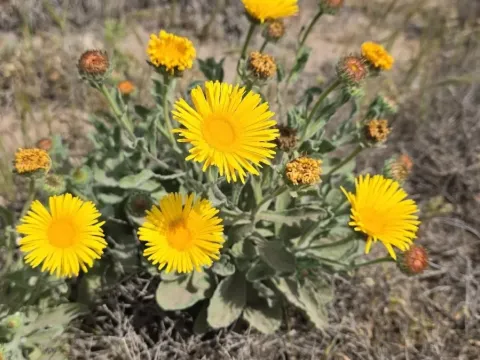
Fleabane
Pulicaria
Fleabane (Pulicaria) is a genus of flowering plants belonging to the Asteraceae family. While often considered a wild plant, it has historical significance for its insect-repelling properties and medicinal applications, leading to its cultivation in niche botanical sectors.
What the section contains
 Arabian fleabane
Pulicaria arabica
Arabian fleabane
Pulicaria arabica
 Common fleabane
Pulicaria dysenterica
Common fleabane
Pulicaria dysenterica
 Common fleabane
Pulicaria vulgaris
Pulicaria auranitica
Pulicaria auranitica
Common fleabane
Pulicaria vulgaris
Pulicaria auranitica
Pulicaria auranitica
 Pulicaria incisa
Pulicaria incisa
Pulicaria incisa
 Pulicaria laciniata
Pulicaria longifolia
Pulicaria longifolia
Pulicaria laciniata
Pulicaria laciniata
Pulicaria longifolia
Pulicaria longifolia
 Pulicaria microcephala
Pulicaria microcephala
Pulicaria microcephala
 Pulicaria odora
Pulicaria odora
Pulicaria odora
 Pulicaria orientalis
Pulicaria orientalis
Pulicaria orientalis
 Pulicaria sicula
Pulicaria sicula
Pulicaria sicula
 Pulicaria undulata
Pulicaria undulata
Pulicaria undulata
Fleabane
The plant is native to a broad range of regions across Europe, Asia, and North Africa. It thrives in temperate to subtropical climates and is highly adapted to damp environments, often colonizing marshy edges, riverbanks, and saline soil conditions that are unsuitable for standard crops.
Agricultural requirements for Pulicaria focus primarily on soil moisture management. It is a moisture-loving plant that requires consistent water availability to maintain vigor. Soils with high organic content or those that remain moist throughout the summer months are considered optimal for yield.
Botanically, the plant is characterized by its bright yellow, daisy-like flower heads and a distinct aromatic foliage. These leaves contain specific sesquiterpene lactones and essential oils that serve as a natural defense mechanism against herbivores and certain insect pests.
In terms of хозяйственное usage, the plant serves as a source for traditional herbal medicine, specifically for its anti-inflammatory and antiseptic properties. Additionally, dried bundles of the plant have been used traditionally as a natural flea repellent, reflecting its scientific name, Pulicaria.