
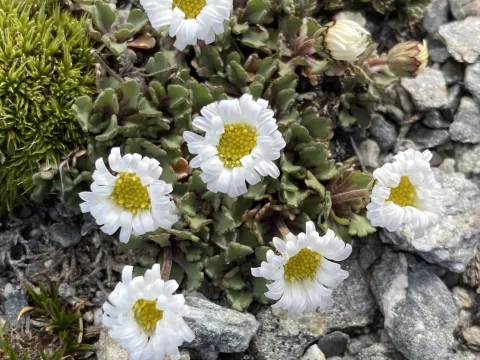
Brachyscome
Brachyscome Cass.
Brachyscome (Brachyscome), commonly known as the Swan River daisy, belongs to the Asteraceae family. It is a popular ornamental crop native to Australia, usually grown as an annual in most climates.
What the section contains
 Brachyscome
 ascendens x curvicarpa
Brachyscome angustifolia
Brachyscome angustifolia x multifida
Brachyscome
Brachyscome ascendens x curvicarpa
Brachyscome angustifolia
Brachyscome angustifolia x multifida
 Brachyscome angustifolia
Brachyscome ascendens
Brachyscome ascendens
Brachyscome curvicarpa
Brachyscome curvicarpa
Brachyscome angustifolia
Brachyscome angustifolia
Brachyscome ascendens
Brachyscome ascendens
Brachyscome curvicarpa
Brachyscome curvicarpa
 Brachyscome formosa
Brachyscome hybrid
Brachyscome formosa x B. segmentosa
Brachyscome formosa
Brachyscome formosa
Brachyscome hybrid
Brachyscome formosa x B. segmentosa
 Brachyscome hybrid
Brachyscome rigidula x multifida
Brachyscome hybrid
Brachyscome rigidula x multifida
 Brachyscome hybrid
Brachyscome segmentosa x procumbens
Brachyscome hybrid
Brachyscome segmentosa x procumbens
 Brachyscome melanocarpa
 F. Muell & Sond.
Brachyscome procumbens
Brachyscome procumbens
Brachyscome rigidula
Brachyscome rigidula
Brachyscome segmentosa
Brachyscome segmentosa x curvicarpa
Brachyscome segmentosa
Brachyscome segmentosa
Brachyscome melanocarpa
Brachyscome melanocarpa F. Muell & Sond.
Brachyscome procumbens
Brachyscome procumbens
Brachyscome rigidula
Brachyscome rigidula
Brachyscome segmentosa
Brachyscome segmentosa x curvicarpa
Brachyscome segmentosa
Brachyscome segmentosa
 Cut-leaf daisy
Brachyscome multifida x curvicarpa
Cut-leaf daisy
Brachyscome multifida DC.
Cut-leaf daisy
Brachyscome multifida x curvicarpa
Cut-leaf daisy
Brachyscome multifida DC.
 Swan River daisy
Brachyscome iberidifolia Benth.
Swan River daisy
Brachyscome iberidifolia Benth.
Brachyscome
The seeds are extremely small and should be sown on the surface of a light, moist substrate. Light is essential for germination, so they should not be covered with a thick layer of soil.
Sowing typically begins in late winter or early spring in greenhouses or indoor seed trays. Maintaining a constant temperature of about 20°C ensures uniform emergence of the seedlings.
Seedlings should be pricked out into individual pots or cell trays when they develop their first set of true leaves. This allows for better root development and easier hardening off before planting.
Transplanting to the permanent outdoor location occurs once the danger of frost has passed. Planting density should be carefully managed, with approximately 20–25 cm spacing to allow for healthy air circulation.
Brachyscome thrives in full sunlight. Choosing a site with maximum daily sun exposure is crucial for the plant to achieve its full potential and produce abundant blooms throughout the season.
The ideal soil is sandy, well-draining, and moderately fertile. The plant is sensitive to waterlogged conditions, which can lead to root rot; therefore, good drainage is a non-negotiable requirement.
Watering should be balanced. While the plant is somewhat drought-tolerant, it performs best when the soil is kept consistently moist but not saturated. Avoid overhead irrigation if possible.
Regular fertilization with a balanced liquid fertilizer every two weeks promotes vigorous growth and continuous flowering. High-phosphorus formulas are particularly effective during the blooming stage.
Pruning and deadheading are important maintenance practices. Removing spent flowers prevents seed formation and redirects the plant's energy toward creating new buds, extending the flowering period.
The primary threat to Brachyscome is root disease associated with excessive soil moisture. Poor drainage during prolonged rainfall can lead to rapid decay of the root system.
Insect pests such as aphids and whiteflies frequently target the tender shoots and leaves. These pests can weaken the plant and serve as vectors for secondary viral infections.
Management of pest outbreaks involves regular monitoring and the application of suitable insecticides. Biological control methods are also effective when used at the first sign of infestation.
Fungal diseases like powdery mildew may occur in stagnant, humid environments. Maintaining adequate spacing between plants is the best preventative strategy against such leaf pathogens.
Early identification of signs of stress is vital for successful cultivation. Keeping the plants clean from debris and ensuring proper ventilation are essential for maintaining plant health throughout the season.