
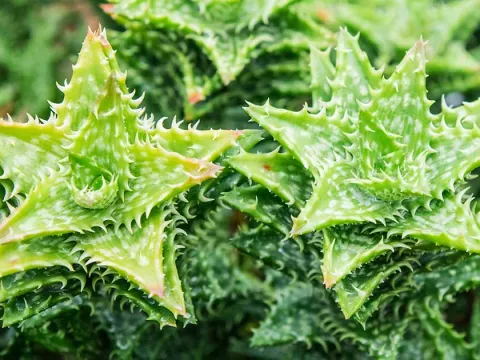
Aloe juvenna
Aloe juvenna
Aloe juvenna is a small, clustering succulent belonging to the Asphodelaceae family. Native to the rocky regions of Kenya, it is highly valued by collectors for its compact, vertical growth habit and unique architectural appearance.
What the section contains
Aloe juvenna
Botanically, this species is characterized by thick, spiny, triangular leaves arranged in tight rosettes that stack to form segmented stems. It can reach a height of up to 20-30 centimeters, often branching at the base as it matures.
The plant requires bright, direct to partial sunlight to maintain its vibrant green color and compact form. In low-light conditions, the stems tend to stretch (etiolate) and become weak, which negatively affects the overall plant health.
Regarding soil requirements, Aloe juvenna demands a fast-draining medium. A mixture consisting of 50% inorganic material, such as perlite or pumice, and 50% organic substrate is ideal for preventing moisture retention near the root zone.
Climate control is crucial, with the plant favoring temperatures between 18 and 24 degrees Celsius during the growing season. It is not frost-tolerant and should be brought indoors or protected when external temperatures drop below 10 degrees Celsius.
The most significant threat to Aloe juvenna is overwatering, which quickly triggers fungal pathogens leading to root rot. If the leaves become translucent or mushy, the plant is likely suffering from excess water in the substrate.
Mealybugs are the primary pest affecting this succulent. They often hide between the tight, overlapping leaves where it is difficult to spot them until an infestation becomes severe, requiring systemic insecticidal treatment.
Scale insects can also infest the stems and undersides of leaves, draining sap and weakening the plant. Mechanical removal using a soft brush dipped in alcohol is often effective for mild cases.
Poor ventilation combined with high humidity can lead to leaf spot disease, characterized by brown or black patches on the leaf surface. Improving airflow around the plant is the best preventive measure.
Always use clean tools and sterile soil when repotting to prevent the introduction of soil-borne pathogens. Monitoring the plant twice a month is usually sufficient to manage pest populations effectively.