
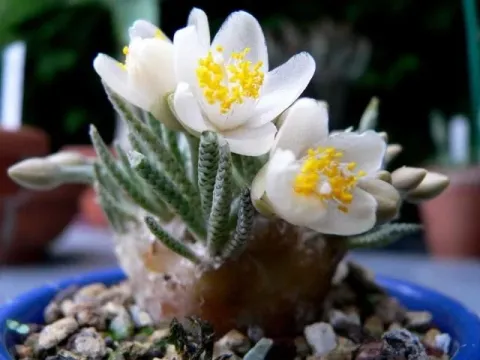
Anacampseros
Anacampseros
Anacampseros is a genus of perennial succulent plants belonging to the family Anacampserotaceae. These miniature plants possess a unique ability to store moisture in their leaves and stems, enabling them to thrive in conditions of extreme aridity.
What the section contains
 Anacampseros aizoon
Anacampseros aizoon
Anacampseros aizoon
 Anacampseros albidiflora
Anacampseros albidiflora
Anacampseros albidiflora
 Anacampseros arachnoides
Anacampseros arachnoides
Anacampseros arachnoides
 Anacampseros filamentosa
Anacampseros filamentosa
Anacampseros filamentosa
 Anacampseros harveyi
Anacampseros harveyi
Anacampseros harveyi
 Anacampseros herreana
Anacampseros herreana
Anacampseros herreana
 Anacampseros namaquensis
Anacampseros namaquensis
Anacampseros namaquensis
 Anacampseros papyracea
Anacampseros papyracea
Anacampseros papyracea
 Anacampseros prominens
Anacampseros prominens
Anacampseros prominens
 Anacampseros quinaria
Anacampseros quinaria
Anacampseros quinaria
 Anacampseros quinarioides
Anacampseros quinarioides
Anacampseros quinarioides
 Anacampseros recurvata
Anacampseros recurvata
Anacampseros recurvata
 Anacampseros retusa
Anacampseros retusa
Anacampseros retusa
 Anacampseros rufescens
Anacampseros rufescens
Anacampseros rufescens
 Anacampseros telephiastrum
Anacampseros telephiastrum
Anacampseros telephiastrum
 Anacampseros tomentosa
Anacampseros tomentosa
Anacampseros tomentosa
Anacampseros
The natural habitat of this crop covers the arid regions of Southern Africa, including Namibia and South Africa. In the wild, they grow in rocky soils where sunlight is intense and annual rainfall is minimal.
For successful cultivation, Anacampseros requires high levels of light. In agronomic conditions, it is essential to provide at least 6 to 8 hours of direct sunlight daily to maintain the compact rosette form of the plant.
The growing medium must have excellent drainage properties. An optimal substrate is a mixture of turf soil combined with coarse sand and gravel chips, which prevents moisture stagnation around the root collar.
The temperature range during the active growing season should be between 22 and 28 degrees Celsius, while during the dormant winter period, the plant requires cool conditions at 10–12 degrees Celsius to stimulate subsequent flowering.
The primary threat to Anacampseros is the overwatering of the substrate. Excessive moisture leads to root rot, which destroys the entire plant rapidly because succulent tissues are prone to quick decay when waterlogged.
In greenhouses or indoor conditions, the crop is susceptible to mealybug infestations. The parasite hides in the leaf axils and among the protective hairs covering many Anacampseros species, making early detection difficult.
Spider mites are another common pest. They become active in low humidity and high temperatures, feeding on the sap of young plant shoots and causing significant stress to the culture.
Scale insects can colonize the stems, forming dense clusters. Infestation by these pests disrupts photosynthesis, leading to deformation of the rosettes and a reduction in the overall immune resistance of the plant.
To control diseases and pests, systemic insecticides and fungicides are used. Prophylaxis involves maintaining optimal ventilation and strictly adhering to a controlled irrigation schedule.