
Anacampseros retusa
Anacampseros retusa
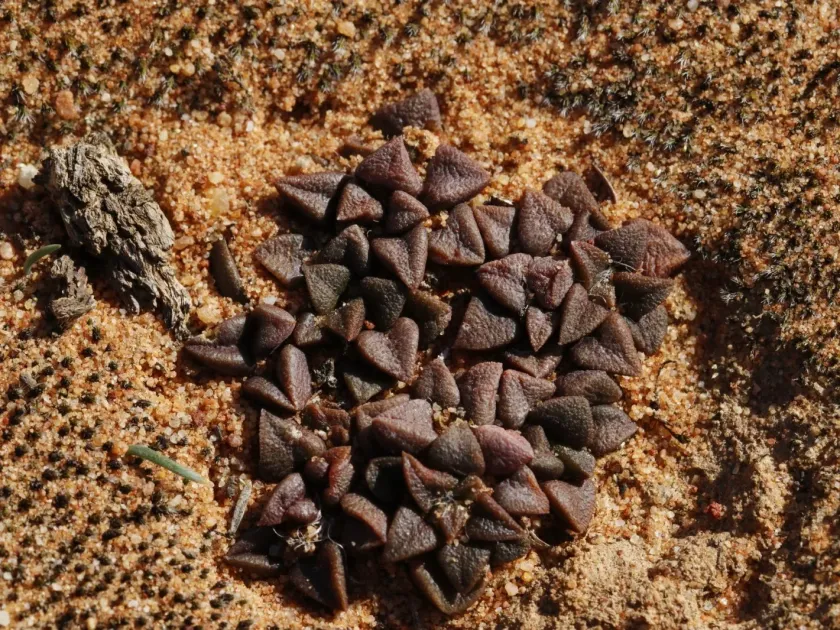
Description
Growing requirements
Anacampseros retusa is a distinctive perennial succulent belonging to the Anacampserotaceae family. It is native to the arid landscapes of South Africa, where it has evolved to thrive in nutrient-poor, rocky soils under intense sunlight.
The plant is characterized by its compact, succulent leaves forming tight rosettes, often adorned with fine white hairs. These hairs serve as an adaptation to reduce moisture loss and protect the plant tissue from excessive UV radiation.
For successful cultivation, a well-draining soil mix is mandatory. A combination of coarse sand, perlite, and a small amount of loamy soil ensures that water does not accumulate around the roots, preventing common physiological issues.
Environmental conditions should mimic its natural habitat. It requires high light intensity; if provided with insufficient light, the plant will quickly become etiolated, losing its compact aesthetic and becoming prone to structural instability.
Watering practices must be strictly controlled according to the season. During the growing season, water thoroughly but only when the soil has completely dried out. In winter, the plant enters dormancy and requires minimal to no water to prevent rot.
Main diseases and pests
The primary threat to Anacampseros retusa is root rot, which occurs due to overly wet substrate or poor drainage. This condition is often fatal and can be avoided by strictly adhering to a dry-cycle watering schedule.
Mealybugs are the most common pest observed in this species. They hide deep within the rosette and beneath the protective hairs, making them difficult to detect until the infestation becomes significant.
Spider mites can also become a problem if the ambient humidity remains too low for an extended period. These pests extract fluids from the succulent tissue, leaving behind discolored spots and affecting overall health.
Scale insects may occasionally appear on the surface of the leaves. Manual removal using a swab dipped in isopropyl alcohol is often the most effective method for light infestations without harming the plant.
In addition to pests, fungal pathogens can develop if the plant is kept in an environment with stagnant air. Maintaining good air circulation is crucial to prevent the proliferation of mold and bacterial infections.