
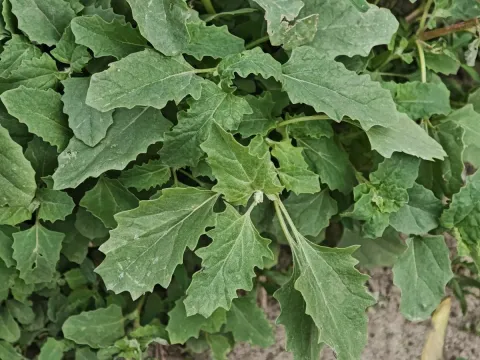
Tatarian orache
Atriplex tatarica
Tatarian orache (Atriplex tatarica) is an annual herbaceous plant belonging to the Amaranthaceae family. It is widely recognized for its robust growth patterns and ability to thrive in environments that are typically hostile to other plant species, including saline and semi-arid soils.
What the section contains
Tatarian orache
The native range of the species extends across Eurasia, from the temperate regions of Europe to the arid areas of Central Asia. As a weed, it frequently colonizes disturbed lands, roadsides, and agricultural fields, often acting as a pioneer species that prepares the soil for secondary succession.
Morphologically, Atriplex tatarica exhibits a branching growth habit with stems that can grow up to 90 centimeters tall. Its leaves are usually triangular or diamond-shaped and are covered with a characteristic mealy, white pubescence, which provides essential protection against intensive solar radiation and desiccation.
This plant has minimal nutritional requirements, thriving in low-fertility, sandy, or saline substrates. It possesses a high degree of drought tolerance, utilizing a deep taproot system to access subterranean water sources during prolonged droughts, which makes it a persistent competitor in agricultural settings.
In modern farming, it is considered a significant weed that competes with cash crops for space and resources. Management strategies focus on disrupting its reproductive cycle, primarily through mechanical tillage and the application of selective herbicides during the early stages of its development.
While the Tatarian orache is highly resistant to many environmental stresses, it is susceptible to various fungal pathogens. Powdery mildew is the most common condition, manifesting as a white, powdery layer on the foliage, which can occasionally inhibit the plant's growth if environmental conditions are humid.
The plant acts as an alternative host for several species of aphids, which are vectors for various plant viruses. This makes the presence of Atriplex tatarica on the edges of fields a potential risk for the health of adjacent vegetable and cereal crops during the growing season.
Insect pests, including various leaf beetles (Chrysomelidae), often graze on the leaves. While these herbivores may cause significant defoliation, they rarely kill the plant due to its vigorous compensatory growth and high seed production capacity, which ensures the survival of the population.
Effective management requires the integration of chemical and cultural practices. It is imperative to prevent the plant from reaching the flowering stage, as a single large specimen can produce thousands of seeds, significantly increasing the soil seed bank for several subsequent seasons.
Crop rotation remains one of the most effective non-chemical methods for controlling the spread of Tatarian orache. By alternating broad-leaved crops with cereals and employing competitive sowing patterns, farmers can suppress weed development and reduce the reliance on chemical inputs.