
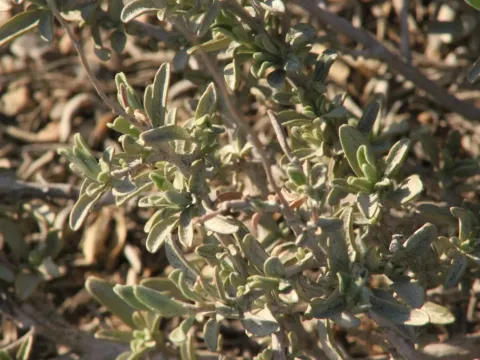
Grey saltbush
Atriplex cana
Sowing of grey saltbush is generally carried out in early spring, as soon as the soil is sufficiently moist from snowmelt, which is crucial for uniform germination in arid regions.
What the section contains
Grey saltbush
The seeds should be planted at a depth of 1–2 centimeters; they possess high germination energy but are highly sensitive to soil surface crusting and compaction.
For establishing a robust stand, agronomists recommend a wide-row planting pattern, which reduces competition for water among the young seedlings.
In natural settings, the plant reproduces via seeds, but in agricultural systems, initial soil preparation including light discing and rolling is advised to ensure optimal seed-to-soil contact.
Environmental temperatures must be consistently above freezing during sowing, as the crop is extremely vulnerable to late frosts during the seedling stage.
Grey saltbush belongs to the Amaranthaceae family and is a specialized xerophyte and halophyte, perfectly adapted to the harsh conditions of semi-deserts and saline lands.
The crop requires high levels of solar radiation and reacts negatively to shading, which significantly limits its potential for intercropping with taller vegetation.
Preferred soil types include solonetzic, chestnut, and sandy soils, where other typical agricultural crops would fail to establish a functional root system.
It displays remarkable drought resistance by developing a deep taproot system, which allows it to access water from deep subsoil horizons during prolonged dry spells.
The chemical composition of the soil is rarely a limiting factor, as the plant is specifically adapted to high salt content, making it an excellent choice for reclaiming degraded areas.
The yield of grey saltbush stands is highly dependent on the local hydro-thermal conditions of the growing season and the age of the pasture or forage plot.
Under optimal conditions during the early years, the yield of green biomass can reach 15–25 quintals per hectare in terms of dry matter.
For grazing purposes, yields are distributed relatively evenly, allowing for a steady and predictable stocking rate throughout the summer months.
Maximum productivity levels are achieved through managed grazing or cutting cycles, which stimulate the growth of lateral shoots and prevent excessive lignification.
In seed production fields, the yield is limited by pollinator activity and atmospheric humidity during flowering, requiring careful monitoring of the panicles.
Major threats to grey saltbush include specialized pests such as the beet leaf miner and various aphids, which can cause significant damage to the foliage.
Fungal diseases, including powdery mildew, are relatively rare but may occur under conditions of abnormally high air humidity and poor ventilation in dense stands.
Soil-dwelling pests like wireworms pose a critical risk during the establishment phase, as they can sever the primary taproot, causing seedling mortality.
Weed competition during the initial growth stage is a serious threat, necessitating the use of mechanical or cultural weed control measures.
Anthropogenic pressure, specifically overgrazing during the early phenological stages, can lead to stand thinning and the degradation of the plant community.
For hay production, harvesting should be performed before the stems become overly lignified, ensuring that the nutritional value of the green mass remains optimal.
When used for grazing, rotational grazing systems allow livestock to efficiently utilize the nutrient-rich, protein-dense leaves of the plant.
Seed harvest occurs after the fruits have turned brown, indicating maturity and ensuring maximum seed viability and fill.
To minimize losses during seed harvesting, direct combining is recommended during the early morning hours to mitigate the risk of shattering.
Post-harvest management of the seeds involves thorough drying using open-air methods or forced ventilation to maintain embryo vitality until the next planting season.