
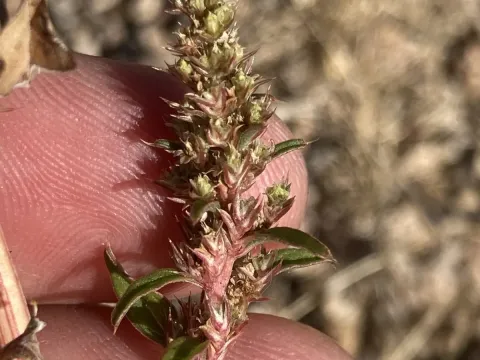
Torrey's amaranth
Amaranthus torreyi
Sowing of Torrey's amaranth is carried out in the spring period when the soil warms up to a temperature of 12–15 degrees Celsius at a depth of up to 10 centimeters. The crop is highly sensitive to cold, so sowing in cold soil leads to delayed germination and an increased risk of seed damage by soil pathogens.
What the section contains
Torrey's amaranth
The optimal sowing method is row cultivation with inter-row spacing of 45 to 70 centimeters, which provides the plant with sufficient space for the development of its powerful root system. Given the small size of the seeds, the planting depth should not exceed 1–2 centimeters to ensure uniform emergence.
For successful germination, the soil must be well-prepared, have a fine-crumb structure, and possess adequate moisture reserves. In arid regions, it is recommended to perform light rolling after sowing to improve contact between the seeds and soil particles.
The seeding rate varies depending on the purpose of cultivation, but generally ranges from 0.5 to 1.5 kilograms per hectare. Excessive plant density negatively affects crop productivity and may lead to thinning of the stands due to intra-species competition.
Seedlings appear 7–12 days after sowing under favorable weather conditions. During this initial phase, the crop grows slowly, so it is crucial to keep the fields free of weeds by performing timely inter-row cultivations.
Torrey's amaranth belongs to the Amaranthaceae family and is a typical plant of arid and semi-arid zones in North America. The crop possesses exceptional resistance to high temperatures and prolonged periods without rainfall, making it a promising option for drought-prone regions.
For optimal growth, the plant requires a high level of sunlight, as it is a light-loving species with a C4 photosynthetic pathway. A lack of sunshine significantly reduces vegetative biomass accumulation and slows down seed maturation.
The species is relatively undemanding regarding soil conditions, although it develops best on well-drained light sandy or loamy soils. Torrey's amaranth does not tolerate heavy, waterlogged soils with stagnant water, which can lead to root rot.
The plant demonstrates high salt tolerance and is capable of thriving on saline soils where other agricultural crops show low productivity. Soil acidity levels should preferably be in the range from slightly acidic to alkaline.
Agronomic management includes mandatory inter-row loosening to control weeds and improve soil aeration. The demand for mineral fertilizers is moderate, although nitrogen application during the initial growth phases significantly stimulates biomass development.
The biomass yield of Torrey's amaranth depends on moisture conditions and soil fertility. Under favorable conditions, the crop is capable of producing a significant volume of above-ground matter, which is used as a valuable fodder component for livestock.
Seed productivity of this species is characterized by high flowering intensity, with a single plant capable of producing thousands of tiny seeds. Seed harvesting requires humidity control, as maturation can be uneven, leading to shattering if left standing too long.
A biological feature of this species is its high efficiency in converting solar energy into organic matter. This allows for stable yields even in years with rainfall deficits, when traditional grain or forage crops may fail.
To improve yield, it is recommended to apply foliar micro-nutrient fertilizers during critical plant development phases. This enhances resistance to environmental stressors and improves the quality of the harvested raw material.
Plant density is also a critical factor; at lower densities, the plant forms larger inflorescences, which facilitates the harvesting process. Statistical yield data vary depending on the specific ecotype of the plant.
Torrey's amaranth possesses natural resistance to many diseases, but poor agronomic practices can lead to fungal infections such as root rot or leaf spots. Prevention mainly involves strict adherence to crop rotation schedules.
Among pests, insects that damage seedlings during the early growth period pose the greatest threat. In particular, weevils and various types of caterpillars can significantly reduce stand density if their populations are not monitored during the initial stages.
During the flowering period, the crop can be targeted by aphids, which suck sap from inflorescences and young leaves. This not only weakens the plant but also promotes the development of secondary viral infections, reducing seed quality.
Nematodes may pose a threat if the crop is grown continuously on the same plot without rotation. In such cases, stunted growth and leaf chlorosis are observed, requiring soil fumigation or deep tillage.
Integrated pest management systems are used to protect the crop, including the timely destruction of weeds, which can act as pest reservoirs. Chemical control methods should be used with caution, taking into account the pre-harvest intervals.
Harvesting of Torrey's amaranth for green fodder is carried out at the beginning of the flowering phase, when the plant has its maximum nutritional value. At this time, the protein content in leaves and stems reaches its peak, which is essential for quality feed.
When grown for seeds, harvesting is conducted when the inflorescences acquire their characteristic color and the seeds become hard and dark. It is crucial not to allow the plants to dry out completely to minimize losses during threshing.
Harvesting technology includes direct combining or pre-mowing into windrows followed by picking. The choice of method depends on the material's moisture content and the regional climatic conditions at the time of seed maturation.
After harvesting, seeds require mandatory cleaning from impurities and drying to a moisture content of 10–12 percent. Storage should be in dry, ventilated facilities protected from moisture and stored-product pests.
The collected vegetative mass can be used fresh or preserved as silage. Silaging Torrey's amaranth is successful when adding carbohydrate-rich additives, which improves fermentation and fodder preservation.