
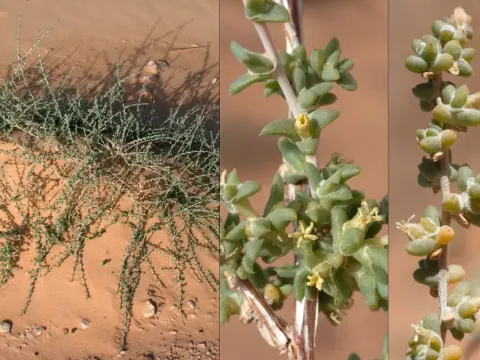
Traganopsis
Traganopsis
Traganopsis is a genus of plants belonging to the Amaranthaceae family, which has evolved to thrive in extreme environmental conditions. As a classic example of a halophyte, this plant is naturally adapted to saline soils, making it an object of interest for land reclamation and the development of arid regions.
What the section contains

Traganopsis
Historically, this culture is distributed across North Africa and the Canary Islands, where hot and arid climates prevail. The plant demonstrates remarkable resilience to drought, maintaining its vegetative growth even under the minimal precipitation characteristic of desert and semi-desert ecosystems.
Botanically, Traganopsis is a semi-shrub featuring highly branched stems and small, often succulent leaves. This physical structure allows the plant to efficiently store moisture and minimize transpiration, which serves as a crucial survival strategy against intense solar radiation and high temperatures.
The plant has specific soil requirements, preferring well-drained, sandy, or loamy substrates with high salinity levels. It plays a vital ecological role in stabilizing shifting sands and preventing soil erosion, which makes it highly valuable for the restoration of degraded agricultural and wild lands.
The primary agricultural use of Traganopsis is linked to pastoral livestock farming in arid zones. Despite its unique chemical profile, it serves as a sustainable source of fodder for camels and small ruminants during periods of feed scarcity, proving its significant adaptive value for desert farming.
In its natural habitat, Traganopsis is susceptible to various pests commonly found in xerophytic vegetation. Insects that target the stems and root systems can significantly impede the development of young plants, thereby weakening their natural resistance to harsh climatic stresses.
Fungal infections pose a serious threat, particularly during infrequent but intense rainfall events. High humidity combined with elevated temperatures can lead to root rot, which spreads rapidly through dense populations of halophytic plants if drainage is not properly managed.
Pests such as locusts represent the most significant threat to the plant's aerial biomass. During outbreak cycles, these insects can completely defoliate young shoots, which is a critical issue for the regeneration of the population within a highly competitive and stressful environment.
Furthermore, one must account for the risk posed by airborne or soil-borne phytopathogens. Preventive agricultural practices include maintaining optimal planting densities and regular soil monitoring to ensure there is no water accumulation in the rhizosphere, which often triggers secondary infections.
Research into Traganopsis diseases remains in the early observational stages. Therefore, current crop protection strategies focus primarily on maintaining an optimal microclimate and conducting rigorous crop health monitoring during active growth seasons to ensure early detection of any emerging pathogens.