
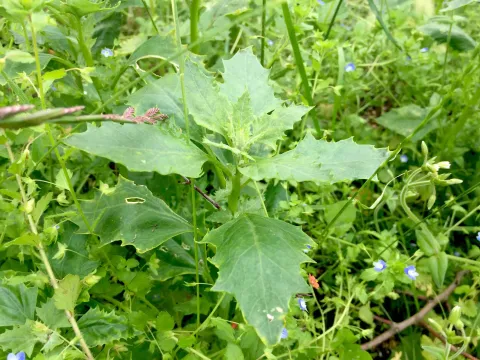
Upright goosefoot
Chenopodium urbicum
Upright goosefoot (Chenopodium urbicum) is an annual herbaceous plant that begins its life cycle in spring when soil temperatures reach favorable levels.
What the section contains
Upright goosefoot
The seeds possess a high degree of longevity, remaining viable in the soil seed bank for several years until the conditions for germination are met.
Seedlings typically emerge in late spring, showing a strong ability to thrive in disturbed soils following cultivation or sowing of field crops.
The species demonstrates high germination energy, allowing it to establish quickly and outcompete many neighboring plants in the early growth stages.
Success in field establishment is largely dependent on soil moisture availability and the presence of sufficient nitrogen, which the plant readily utilizes.
Belonging to the Amaranthaceae family, this species prefers nitrogen-rich, loose, and fertile soil conditions to reach its maximum vegetative potential.
It is known for its high ecological plasticity, enabling it to colonize diverse environments, including roadsides, waste areas, and agricultural fields.
The plant thrives under moderate climatic conditions, showing resilience against environmental stressors such as fluctuating moisture levels and heat.
Light requirements are relatively flexible, allowing the species to develop in full sun or partially shaded conditions near farm structures or field margins.
Optimal growth is observed in well-drained, nutrient-dense soils where competition from other fast-growing species is temporarily reduced by tillage.
Upright goosefoot exhibits high biological productivity, with individual plants capable of producing thousands of seeds throughout the season.
The accumulation of biomass is rapid during the peak of summer, which can lead to significant competition with main crops if not managed correctly.
Economic use of this plant is minimal, as it is primarily classified as an invasive weed that decreases the overall yield of cultivated plants.
Seeds are easily dispersed via wind, water, and agricultural equipment, contributing to the persistent nature of the plant in large-scale farming.
The nutritional content of the foliage is high in minerals, but its use as fodder is limited due to the potential for nitrate accumulation in plant tissues.
The species is remarkably robust and displays natural resistance to many pathogens that commonly affect sensitive field and vegetable crops.
While various insect pests may graze on the leaves, they rarely cause sufficient damage to control the population density of the plant effectively.
As a potential host for viral pathogens, the plant acts as a reservoir for diseases that may be transmitted to crops by aphid or leafhopper vectors.
Integrated weed management, including mechanical hoeing and the strategic use of herbicides, is necessary to keep populations below economic damage thresholds.
Crop rotation remains the most effective long-term strategy for minimizing the impact of this species in fields dedicated to grain or pulse production.
Seed maturity is reached by late summer, requiring timely intervention to prevent the massive dispersal of seeds back into the soil profile.
Mechanical harvesting equipment must be cleaned thoroughly after operating in infested areas to avoid the accidental spread of seeds to clean ground.
Post-harvest management should include shallow cultivation to stimulate germination, followed by the destruction of seedlings before they set new seeds.
Proper timing of cutting or mowing is crucial; intervention must occur prior to the onset of seed development to ensure long-term population reduction.
Sustainable control methods focus on minimizing the seed bank size through a combination of manual removal and targeted crop maintenance practices.