
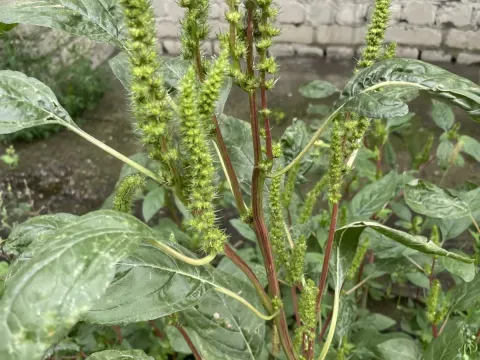
Powell's amaranth
Amaranthus powellii
Powell's amaranth belongs to the Amaranthaceae family and is recognized as a vigorous annual plant that thrives in temperate and subtropical regions.
What the section contains
Powell's amaranth
Seed germination typically occurs in late spring when soil temperatures reach 15°C, ensuring a rapid start for the season's vegetative growth.
The seeds possess high levels of dormancy and longevity, allowing them to remain viable in the soil seed bank for several years under varying conditions.
When cultivated intentionally, planting should be done at a shallow depth of 1–2 cm to ensure optimal contact with moist soil for uniform emergence.
The species exhibits a competitive growth strategy, quickly developing a rosette of leaves that effectively shades the soil surface and inhibits competing species.
This plant is highly heliophilic, meaning it requires full exposure to direct sunlight for maximum development and dry matter accumulation.
Powell's amaranth performs best in fertile, well-drained loamy soils rich in organic matter and nitrogen, which are critical for its tall, robust stems.
It is moderately drought-tolerant due to an extensive taproot system that can access deep soil moisture during dry summer months.
While tolerant of various soil types, it prefers neutral pH conditions and struggles in highly compacted or waterlogged environments where aeration is poor.
The plant thrives under warm temperature regimes, showing accelerated growth rates as daily highs remain consistently above 20°C during mid-summer.
The plant is susceptible to several fungal pathogens, including white mold and various leaf spots, especially in regions with high humidity or frequent rainfall.
Common insect pests include foliage-feeding caterpillars, such as the beet webworm, which can significantly reduce the photosynthetic leaf area.
Control methods often involve a combination of mechanical hoeing and the targeted use of herbicides, although resistance issues have been documented in specific populations.
Integrated pest management strategies are crucial, as reliance on a single chemical class can lead to the rapid selection of resistant amaranth biotypes.
- Mechanical cultivation of inter-rows.
- Rotation with competitive winter crops.
- Crop residue management to suppress germination.
Harvesting for green fodder should be timed to coincide with the late vegetative phase, just before the formation of the inflorescence, to maximize nutritional quality.
In seed production, harvest occurs when the inflorescence turns a dull brown color and seeds begin to dry naturally, indicating physiological maturity.
Specialized harvesting equipment, such as combines with reduced fan speeds, is required to prevent the loss of extremely tiny seeds during the threshing process.
Post-harvest drying is essential to prevent heating and mold development in stored seed batches, maintaining a moisture content of below 13% for long-term storage.
For industrial use, the biomass must be processed quickly to retain nutrient integrity, either through silage fermentation or mechanical dehydration techniques.