
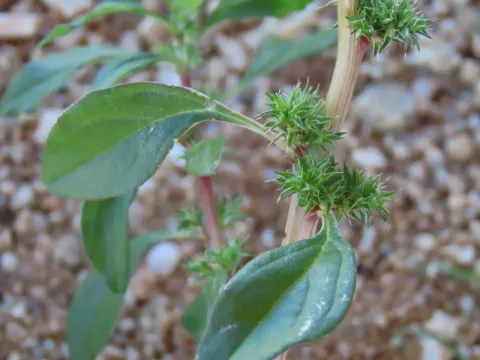
Dinter's Amaranth
Amaranthus dinteri
Dinter's Amaranth is a heat-loving crop, so sowing times are dependent on the soil reaching full warmth. It is optimal to begin sowing when the surface soil temperature at a depth of 5-10 cm reaches a stable +15...+18°C.
What the section contains
Dinter's Amaranth
In temperate climates, sowing is carried out in late May or early June, once the threat of night frosts has passed. Planting too early in cold soil leads to delayed seed germination and leaves the seedlings vulnerable to root rot.
The seeds of this crop are fine-grained, requiring shallow planting at a depth of no more than 1-2 cm. During sowing, it is essential to ensure good soil-to-seed contact to achieve uniform germination.
The optimal sowing pattern depends on the intended use: for green biomass, a row method with 15-30 cm spacing is used, while for grain production, a wide-row method with 45-70 cm spacing is preferred.
If early production is required, a transplanting method is possible, although direct sowing into the ground after stable summer weather is established is the standard practice in industrial farming.
Dinter's Amaranth is a drought-tolerant plant adapted to semi-desert and steppe zones. Native to the arid regions of Southern Africa, it exhibits high adaptability to conditions of moisture deficiency.
The crop has moderate soil requirements, preferring well-aerated loamy and sandy soils. The plant is capable of growing in saline areas where other agricultural crops show low productivity.
Amaranth requires plenty of sunlight for intensive growth, as it utilizes C4 photosynthesis. Even slight shading can lead to a sharp decrease in biomass and delay seed ripening.
The crop responds positively to nitrogen fertilization, although excess organic matter may lead to nitrate accumulation in the green mass. Maintaining optimal levels of phosphorus and potassium is crucial for strengthening the root system.
The plant successfully competes with weeds in the initial stages of growth due to its powerful taproot, though it requires regular cultivation between rows to improve aeration in the root zone.
The productivity of Dinter's Amaranth is determined by regional climate conditions and the level of agricultural management. In favorable years with sufficient warmth, green biomass yields can reach 30-50 tons per hectare.
When grown for grain, the yield potential ranges from 1.5 to 2.5 tons per hectare. A key factor is maintaining the correct plant density, which should be approximately 70,000-100,000 plants per hectare.
Harvesting grain is complicated by uneven ripening, requiring careful monitoring of inflorescence moisture. If the crop stays in the field too long, significant yield losses can occur due to seed shattering.
Crop quality directly depends on harvest timing; for forage purposes, cutting is performed at the onset of flowering, when the protein content in the aerial part of the plant is at its peak.
In intensive agriculture, using varieties derived from this species allows for stable yields of high-protein raw materials even under extreme drought conditions.
Dinter's Amaranth is characterized by high biological resistance to diseases typical of other Amaranthaceae species. However, under conditions of waterlogged soil, outbreaks of fungal diseases such as Fusarium may occur.
Among pests, weevils pose the greatest danger to crops, damaging the root zone and stems of young plants. During severe drought periods, locusts may migrate into the fields.
To protect the crops, implementing a crop rotation system that avoids continuous amaranth monocropping is recommended. This interrupts the breeding cycle of specific pests and soil-borne pathogens.
Chemical control measures are justified only during periods of mass pest infestation. In most cases, timely mechanical soil cultivation is sufficient to suppress infection hotspots.
- Regular inspection of crops for leaf spot symptoms.
- Monitoring insect pest populations during the budding stage.
- Control of soil moisture levels during seed germination.
Harvesting Dinter's Amaranth for green mass is carried out at the flowering stage, when the plant has accumulated maximum nutrients. This results in high-quality silage or hay for livestock feed.
When harvesting for grain, work begins when seeds become firm and assume their characteristic color, and the inflorescences noticeably fade or turn brownish. Seed moisture should not exceed 14-16%.
For direct combine harvesting, precise drum adjustment is required to minimize the crushing of small amaranth seeds. A two-phase harvesting method, involving cutting into windrows for further ripening, is often preferred.
Post-harvest processing involves mandatory cleaning from plant residues and drying to standard moisture content. Long-term storage requires ventilated containers to prevent spoilage.
Timeliness of harvest is a critical factor, as Dinter's Amaranth tends to lose seeds quickly if unfavorable weather conditions occur during the ripening process.