
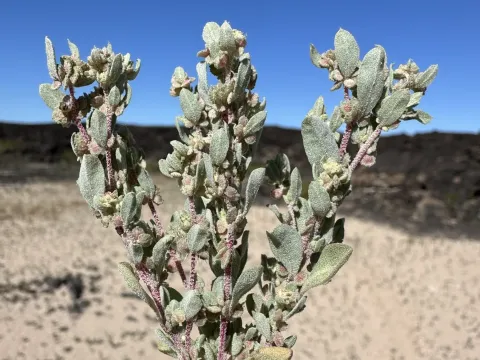
Elegant saltbush
Atriplex elegans
Elegant saltbush is a heat-loving annual herb that thrives in environments where most common crops struggle to establish due to moisture or soil stress.
What the section contains
Elegant saltbush
The sowing process is generally initiated when soil temperatures reach a level conducive to rapid germination, typically in the late spring period.
Seeds should be distributed evenly, ensuring adequate seed-to-soil contact, which is vital for the germination of such small and hardy seeds.
Spacing during planting is a key factor, as the plants tend to develop a bush-like habit that requires sufficient room for proper air circulation.
Farmers often monitor local meteorological data to avoid planting before the last frost, ensuring the seedlings have a long and warm growing season.
As a member of the Amaranthaceae family, Atriplex elegans is highly adapted to arid conditions and is widely recognized for its salinity tolerance.
It prefers well-drained, alkaline or saline soils, where its specialized salt-excreting glands allow it to flourish in challenging environments.
Full solar exposure is mandatory for this plant, as its metabolism is optimized for high light intensity and long, hot summer days in its native range.
The water requirements are low, making this an excellent candidate for regions facing water scarcity or where irrigation water is highly mineralized.
Soil nutrient requirements are relatively low compared to intensive crops, as the species has evolved to forage efficiently in poor, desert-like soils.
While robust, the plant can be vulnerable to powdery mildew if cultivated in environments with high humidity and poor cross-ventilation between rows.
Insect pests such as leaf miners and certain aphid species can cause aesthetic and functional damage to the leaves, potentially reducing photosynthetic rate.
Root-knot nematodes may become a problem in certain soil types, requiring strict adherence to crop rotation practices to break the parasite life cycle.
Integrated pest management strategies are advised, focusing on biological controls that do not disturb the natural resilience of the saltbush population.
Effective crop management, including regular field inspections, remains the most reliable method to manage potential outbreaks and ensure stable yield.