
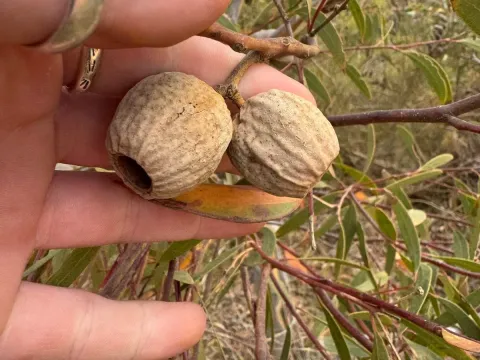
Eucalyptus
Eucalyptus L'Hér.
Eucalyptus propagation is primarily carried out in greenhouses to ensure optimal conditions for seedling development. The seeds, known for their high viability, require precise temperature control, typically between 20°C and 25°C, and consistent moisture levels in the substrate.
What the section contains
 Argyle apple
Eucalyptus cinerea F. Muell. ex Benth.
Argyle apple
Eucalyptus cinerea F. Muell. ex Benth.
 Bangalay
Eucalyptus botryoides Sm.
Bangalay
Eucalyptus botryoides Sm.
 Bentham's gum
Eucalyptus benthamii Maiden & Cambage
Bentham's gum
Eucalyptus benthamii Maiden & Cambage
 Blackbutt
Eucalyptus pilularis Sm.
Blackbutt
Eucalyptus pilularis Sm.
 Blue gum
Eucalyptus globulus Labill.
Blue gum
Eucalyptus globulus Labill. subsp. globulus
Blue gum
Eucalyptus globulus Labill.
Blue gum
Eucalyptus globulus Labill. subsp. globulus
 Blue Mallee
Eucalyptus polybractea R. T. Baker
Blue Mallee
Eucalyptus polybractea R. T. Baker
 Brown stringybark
Eucalyptus obliqua L'Hér.
Brown stringybark
Eucalyptus obliqua L'Hér.
 Cabbage gum
Eucalyptus amplifolia Naudin
Cabbage gum
Eucalyptus amplifolia Naudin
 Candlebark
Eucalyptus rubida H. Deane & Maiden
Candlebark
Eucalyptus rubida H. Deane & Maiden
 Coolibah
Eucalyptus microtheca F. Muell.
Coolibah
Eucalyptus microtheca F. Muell.
 Dunn's white gum
Eucalyptus dunnii Maiden
Dunn's white gum
Eucalyptus dunnii Maiden
 Eucalyptus astringens
 (Maiden) Maiden
Eucalyptus astringens
Eucalyptus astringens (Maiden) Maiden
 Eucalyptus bridgesiana
 R. T. Baker
Eucalyptus bridgesiana
Eucalyptus bridgesiana R. T. Baker
 Eucalyptus caesia
 Benth.
Eucalyptus caesia
Eucalyptus caesia Benth.
 Eucalyptus cloeziana
 F. Muell.
Eucalyptus cloeziana
Eucalyptus cloeziana F. Muell.
 Eucalyptus conica
Eucalyptus conica
Eucalyptus conica
 Eucalyptus crucis
 Maiden
Eucalyptus crucis
Eucalyptus crucis Maiden
 Eucalyptus cypellocarpa
 L. A. S. Johnson
Eucalyptus cypellocarpa
Eucalyptus cypellocarpa L. A. S. Johnson
 Eucalyptus deanei
 Maiden
Eucalyptus deanei
Eucalyptus deanei Maiden
 Eucalyptus delegatensis
 R. T. Baker
Eucalyptus delegatensis
Eucalyptus delegatensis R. T. Baker
 Eucalyptus dorrigoensis
 (Blakely) L. A. S. Johnson & K. D. Hill
Eucalyptus dunnii x Eucalyptus globulus hybrid
Eucalyptus dunnii x Eucalyptus globulus subsp. globulus
Eucalyptus dorrigoensis
Eucalyptus dorrigoensis (Blakely) L. A. S. Johnson & K. D. Hill
Eucalyptus dunnii x Eucalyptus globulus hybrid
Eucalyptus dunnii x Eucalyptus globulus subsp. globulus
 Eucalyptus elata
 Dehnh.
Eucalyptus elata
Eucalyptus elata Dehnh.
 Eucalyptus erythronema
 Turcz.
Eucalyptus erythronema
Eucalyptus erythronema Turcz.
 Eucalyptus fastigata
 H. Deane & Maiden
Eucalyptus fastigata
Eucalyptus fastigata H. Deane & Maiden
 Eucalyptus grandis
 W. Hill ex Maiden
Eucalyptus grandis
Eucalyptus grandis W. Hill ex Maiden
 Eucalyptus grandis x camaldulensis
Eucalyptus grandis (Hill ex Maiden) x E. camaldulensis (Dehn)
Eucalyptus grandis x camaldulensis
Eucalyptus grandis (Hill ex Maiden) x E. camaldulensis (Dehn)
 Eucalyptus grandis x Eucalyptus globulus hybrid
Eucalyptus grandis x Eucalyptus globulus subsp. globulus
Eucalyptus grandis x Eucalyptus globulus hybrid
Eucalyptus grandis x Eucalyptus globulus subsp. globulus
 Eucalyptus grandis x urophylla
Eucalyptus grandis x Eucalyptus urophylla
Eucalyptus grandis x urophylla
Eucalyptus grandis x Eucalyptus urophylla
 Eucalyptus gunnii
 Hook. f.
Eucalyptus gunnii
Eucalyptus gunnii Hook. f.
 Eucalyptus largiflorens
 F. Muell.
Eucalyptus largiflorens
Eucalyptus largiflorens F. Muell.
 Eucalyptus macrorhyncha
 F. Muell. ex Benth.
Eucalyptus macrorhyncha
Eucalyptus macrorhyncha F. Muell. ex Benth.
 Eucalyptus mannifera
 Mudie
Eucalyptus mannifera
Eucalyptus mannifera Mudie
 Eucalyptus marginata
 Donn ex Sm.
Eucalyptus marginata
Eucalyptus marginata Donn ex Sm.
 Eucalyptus moluccana
 Roxb.
Eucalyptus moluccana
Eucalyptus moluccana Roxb.
 Eucalyptus occidentalis
 Endl.
Eucalyptus occidentalis
Eucalyptus occidentalis Endl.
 Eucalyptus orbifolia
 F. Muell.
Eucalyptus orbifolia
Eucalyptus orbifolia F. Muell.
 Eucalyptus paniculata
 Sm.
Eucalyptus paniculata
Eucalyptus paniculata Sm.
 Eucalyptus pellita
 F. Muell.
Eucalyptus pellita
Eucalyptus pellita F. Muell.
 Eucalyptus regnans
 F. Muell.
Eucalyptus regnans
Eucalyptus regnans F. Muell.
 Eucalyptus saligna
 Sm.
Eucalyptus saligna
Eucalyptus saligna Sm.
 Eucalyptus sideroxylon
 A. Cunn. ex Woolls
Eucalyptus sideroxylon
Eucalyptus sideroxylon A. Cunn. ex Woolls
 Eucalyptus sieberi
 L. A. S. Johnson
Eucalyptus sieberi
Eucalyptus sieberi L. A. S. Johnson
 Eucalyptus smithii
 R. T. Baker
Eucalyptus smithii
Eucalyptus smithii R. T. Baker
 Eucalyptus urophylla
 S. T. Blake
Eucalyptus urophylla x viminalis
Eucalyptus urophylla x Eucalyptus viminalis
Eucalyptus urophylla
Eucalyptus urophylla S. T. Blake
Eucalyptus urophylla x viminalis
Eucalyptus urophylla x Eucalyptus viminalis
 Eucalyptus youngiana
 F. Muell.
Eucalyptus youngiana x Eucalyptus macrocarpa hybrid
Eucalyptus youngiana F. Muell. x Eucalyptus macrocarpa Hook.
Eucalyptus youngiana
Eucalyptus youngiana F. Muell.
Eucalyptus youngiana x Eucalyptus macrocarpa hybrid
Eucalyptus youngiana F. Muell. x Eucalyptus macrocarpa Hook.
 Flooded gum
Eucalyptus rudis Endl.
Flooded gum
Eucalyptus rudis Endl.
 Forest red gum
Eucalyptus tereticornis Sm.
Hybrid eucalyptus
Eucalyptus urophylla x Eucalyptus grandis x Eucalyptus globulus
Hybrid of Webster's mallee and round-leaved eucalyptus
Eucalyptus websteriana ssp. norsemanica x E. orbifolia
Forest red gum
Eucalyptus tereticornis Sm.
Hybrid eucalyptus
Eucalyptus urophylla x Eucalyptus grandis x Eucalyptus globulus
Hybrid of Webster's mallee and round-leaved eucalyptus
Eucalyptus websteriana ssp. norsemanica x E. orbifolia
 Irby's Eucalyptus
Eucalyptus x irbyi R. T. Baker & H. G. Sm.
Irby's Eucalyptus
Eucalyptus x irbyi R. T. Baker & H. G. Sm.
 Karri
Eucalyptus diversicolor F. Muell.
Maiden's gum
Eucalyptus globulus Labill. subsp. maidenii (F. Muell.) J. B. Kirkp.
Karri
Eucalyptus diversicolor F. Muell.
Maiden's gum
Eucalyptus globulus Labill. subsp. maidenii (F. Muell.) J. B. Kirkp.
 Manna gum
Eucalyptus viminalis Labill.
Manna gum
Eucalyptus viminalis Labill.
 Mottlecah
Eucalyptus macrocarpa Hook.
Mottlecah
Eucalyptus macrocarpa Hook.
 Mountain Gum
Eucalyptus dalrympleana Maiden
Mountain Gum
Eucalyptus dalrympleana Maiden
 Narrow-leaved peppermint
Eucalyptus radiata Sieber ex DC.
Narrow-leaved peppermint
Eucalyptus radiata Sieber ex DC.
Eucalyptus
Transplanting seedlings to the field is performed in the spring, once the risk of frost has passed. Ensuring that the root system is well-developed before transfer is crucial for successful establishment and survival in the plantation environment.
Soil preparation involves deep plowing and the integration of organic amendments to support rapid initial growth. Maintaining proper spacing between plants is essential to reduce competition for light and nutrients during the critical establishment phase.
In large-scale commercial plantations, planting is often done in furrows to facilitate mechanical maintenance and irrigation. The density of planting is strategically chosen based on the intended use, whether for pulpwood, timber, or essential oil production.
Eucalyptus L'Hér. belongs to the Myrtaceae family and is widely recognized for its rapid growth rate. This biological efficiency allows the crop to produce significant biomass in a relatively short period, making it a key species in global forestry.
Eucalyptus trees are highly photophilic and require full exposure to sunlight to maximize metabolic rates and timber production. Any significant shading can stunt growth and negatively impact the overall wood quality and density of the stand.
The species prefers well-drained, fertile soils with a pH ranging from neutral to slightly acidic. Waterlogged conditions are detrimental as they can cause root rot, therefore effective drainage systems are vital on heavier soil types.
Climate is the primary limiting factor for Eucalyptus expansion, as most species are indigenous to tropical and subtropical regions of Australia. While some hardy varieties exist, most commercial cultivars are susceptible to prolonged freezing temperatures.
Water management is crucial during the first two years of growth. Although mature trees demonstrate impressive drought tolerance due to their specialized leaves, implementing drip irrigation systems is necessary in arid climates to guarantee optimal biomass yield.
Balanced fertilization, particularly with nitrogen, phosphorus, and potassium, is required to maintain high growth rates. Regular soil analysis is recommended to adjust nutrient supply based on the specific needs of the Eucalyptus variety and site conditions.
Eucalyptus stands are among the most productive forest crops in the world. Their ability to generate high volumes of biomass in short rotations provides significant economic advantages compared to slower-growing softwood and hardwood species.
The primary economic applications for Eucalyptus include the pulp and paper industry, as well as the production of timber for furniture and construction. Additionally, leaves are processed for essential oils, specifically cineole, which is highly valued in medicine.
For pulpwood production, harvests can occur as early as 7 to 10 years after planting. This short harvest cycle allows for quick financial turnover and makes the crop highly attractive for intensive forestry investments in suitable climatic zones.
The ability of Eucalyptus stumps to regenerate via coppicing after harvest allows for multiple successive crops without the need for replanting. This sustainable practice significantly reduces establishment costs for subsequent rotation cycles.
Essential oil yield depends heavily on the specific species and the age of the harvested foliage. Harvesting is carefully scheduled when the concentration of volatile compounds is at its peak to ensure the highest commercial oil quality.
Fungal infections, including leaf spots and root rots, are the most common threats, particularly in humid or overcrowded conditions. Fungicidal treatments combined with proper thinning to improve air circulation are effective management strategies.
Insect pests, such as leaf beetles and weevils, can cause significant foliage loss, which reduces the tree's photosynthetic capacity and slows growth. Integrated pest management, including biological controls, is vital for large-scale plantation health.
Vascular pests like certain bark beetles can lead to tree mortality if infestations are not detected early. Continuous monitoring using pheromone traps and conducting timely sanitary thinning are essential practices to protect the plantation's integrity.
Abiotic factors like heavy winds and hail can cause mechanical damage, creating entry points for secondary infections. Proper canopy management and site selection, away from high-wind corridors, help minimize these environmental risks.
Adhering to strict phytosanitary regulations regarding the import and handling of seedlings is the first line of defense against invasive pests and diseases. Utilizing resistant clones remains the most effective tool in modern, sustainable Eucalyptus farming.
Harvesting timber is typically performed using automated logging equipment, which optimizes the cutting process and improves wood processing efficiency. Efficient logistics ensure that logs are transported to mills immediately to maintain timber quality.
Harvest timing is dictated by target diameter and timber quality requirements. While pulpwood focuses on volume growth, timber for high-end construction requires longer rotation times to achieve the necessary wood density and structural properties.
When harvesting leaves for oil extraction, specialized mechanical cutters are used to collect young shoots. Speed is essential, as the volatile oils begin to dissipate immediately after harvest, requiring rapid transport to distillation facilities.
Post-harvest management involves clearing slash and debris to reduce fire hazards and disease transmission. Simultaneously, thinning the coppice regrowth ensures that the remaining shoots develop into high-quality, straight stems for the next crop.
Post-harvest logistics and primary processing, including debarking and drying, are critical to meeting market standards. Because Eucalyptus has high moisture content, controlled drying is essential to prevent warping and degradation of the final wood products.