
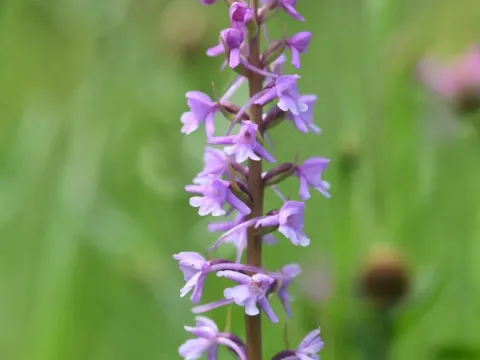
Gymnadenia
Gymnadenia
The genus Gymnadenia, commonly known as fragrant orchids, belongs to the Orchidaceae family. These perennial plants are characterized by their tuberous roots and dense, spike-like inflorescences that emit a sweet, pleasant fragrance.
What the section contains
 Archduke Johann's Gymnadenia
Gymnadenia archiducis-joannis
Archduke Johann's Gymnadenia
Gymnadenia archiducis-joannis
 Austrian vanilla orchid
Gymnadenia austriaca
Austrian vanilla orchid
Gymnadenia austriaca
 Fragrant orchid
Gymnadenia conopsea
Fragrant orchid
Gymnadenia conopsea
 Fragrant orchid
Gymnadenia odoratissima
Fragrant orchid
Gymnadenia odoratissima
 Gymnadenia corneliana
Gymnadenia corneliana
Gymnadenia corneliana
 Gymnadenia dolomitensis
Gymnadenia dolomitensis
Gymnadenia dolomitensis
 Gymnadenia gabasiana
Gymnadenia gabasiana
Gymnadenia gabasiana
 Gymnadenia lithopolitanica
Gymnadenia lithopolitanica
Gymnadenia lithopolitanica
 Gymnadenia rhellicani
Gymnadenia rhellicani
Gymnadenia rhellicani
 Gymnadenia runei
Gymnadenia runei
Gymnadenia runei
 Gymnadenia stiriaca
Gymnadenia stiriaca
Gymnadenia stiriaca
 Marsh fragrant orchid
Gymnadenia densiflora
Marsh fragrant orchid
Gymnadenia densiflora
 Pyrenean gymnadenia
Gymnadenia pyrenaica
Pyrenean gymnadenia
Gymnadenia pyrenaica
 Red vanilla orchid
Gymnadenia rubra
Red vanilla orchid
Gymnadenia rubra
 Small-flowered fragrant orchid
Gymnadenia borealis
Small-flowered fragrant orchid
Gymnadenia borealis
 Vanilla Orchid
Gymnadenia nigra
Vanilla Orchid
Gymnadenia nigra
 Widder's Gymnadenia
Gymnadenia widderi
Widder's Gymnadenia
Gymnadenia widderi
Gymnadenia
Originating primarily from the temperate regions of Eurasia, these plants inhabit diverse landscapes including limestone grasslands, moist meadows, and open woodlands. Their distribution reflects a preference for temperate climates with stable moisture levels.
Cultivation requirements for Gymnadenia are highly specialized. Successful growth depends on the presence of symbiotic mycorrhizal fungi in the soil, which are essential for nutrient uptake. They prefer well-drained, nutrient-poor to moderately fertile alkaline or neutral substrates.
Botanically, the plant develops a rosette of leaves during the spring, followed by an elongated flowering stem. The flower structures are adapted for specific pollinators, and the plant's strategy is to invest heavily in reproductive output during the brief growing season.
Historically, the tubers of various species have been harvested to produce 'salep', a starchy powder used in food preparation and traditional medicine. This utility highlights the role of these plants as a source of biological compounds with soothing and nutritional properties.
The primary threats to Gymnadenia populations include habitat destruction, land development, and changes in traditional land management practices such as hay meadow harvesting.
Pathogen risks include fungal infections that manifest as root rot, often triggered by waterlogged conditions that inhibit gas exchange in the root zone.
Pest pressure is frequently observed from mollusks like snails and slugs, which can consume significant portions of the foliage, particularly in damp and mild weather conditions.
Competition from aggressive grass species and invasive weeds in poorly maintained plots often leads to the decline of individual plants, as orchids are generally poor competitors.
Given the slow germination process and the high dependency on soil microbiome stability, recovery from environmental disturbance or over-harvesting is exceptionally slow for this genus.