
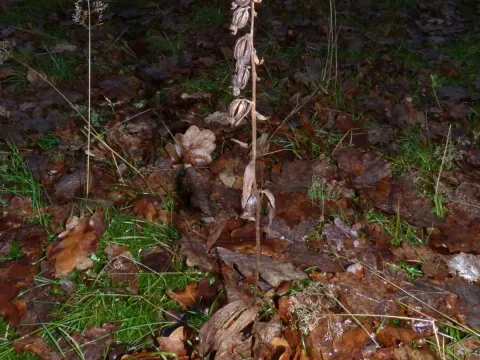
Helleborine
Epipactis
Helleborine (Latin: Epipactis) is a genus of perennial herbaceous plants belonging to the Orchidaceae family. Unlike traditional agricultural crops, these plants are not cultivated for mass production due to their complex biological dependencies and strict ecological niches.
What the section contains
 Beech Helleborine
Epipactis fageticola
Beech Helleborine
Epipactis fageticola
 Bithynian helleborine
Epipactis bithynica
Bithynian helleborine
Epipactis bithynica
 Broad-leaved Helleborine
Epipactis cardina
Broad-leaved Helleborine
Epipactis cardina
 Dark-red helleborine
Epipactis atrorubens
Dark-red helleborine
Epipactis atrorubens
 Dune Helleborine
Epipactis dunensis
Dune Helleborine
Epipactis dunensis
 Dutch helleborine
Epipactis neerlandica
Dutch helleborine
Epipactis neerlandica
 Elbe Helleborine
Epipactis albensis
Elbe Helleborine
Epipactis albensis
 Epipactis condensata
Epipactis condensata
Epipactis condensata
 Epipactis fibri
Epipactis fibri
Epipactis fibri
 Epipactis greuteri
Epipactis greuteri
Epipactis greuteri
 Epipactis hybrids
Epipactis hybrids
Epipactis hybrids
 Epipactis nordeniorum
Epipactis nordeniorum
Epipactis nordeniorum
 Epipactis papillosa
Epipactis papillosa
Epipactis papillosa
 Epipactis provincialis
Epipactis sancta
Epipactis sancta
Epipactis provincialis
Epipactis provincialis
Epipactis sancta
Epipactis sancta
 Epipactis thunbergii
Epipactis thunbergii
Epipactis thunbergii
 Epipactis veratrifolia
Green-flowered helleborine
Epipactis phyllanthes
Epipactis veratrifolia
Epipactis veratrifolia
Green-flowered helleborine
Epipactis phyllanthes
 Klein's Helleborine
Epipactis kleinii
Klein's Helleborine
Epipactis kleinii
 Lusitanian helleborine
Epipactis lusitanica
Lusitanian helleborine
Epipactis lusitanica
 Marsh helleborine
Epipactis palustris
Marsh helleborine
Epipactis palustris
 Mueller's Helleborine
Epipactis muelleri
Mueller's Helleborine
Epipactis muelleri
 Narrow-lipped helleborine
Epipactis leptochila
Narrow-lipped helleborine
Epipactis leptochila
 Persian Helleborine
Epipactis exilis
Persian Helleborine
Epipactis persica
Persian Helleborine
Epipactis exilis
Persian Helleborine
Epipactis persica
 Placentina helleborine
Epipactis placentina
Pontic Helleborine
Epipactis pontica
Placentina helleborine
Epipactis placentina
Pontic Helleborine
Epipactis pontica
 Rhone Helleborine
Epipactis rhodanensis
Rhone Helleborine
Epipactis rhodanensis
 Royle's Helleborine
Epipactis royleana
Royle's Helleborine
Epipactis royleana
 Small-leaved Helleborine
Epipactis microphylla
Small-leaved Helleborine
Epipactis microphylla
 Stream orchid
Epipactis gigantea
Tremols' helleborine
Epipactis tremolsii
Troodos helleborine
Epipactis troodii
Turkish Helleborine
Epipactis turcica
Stream orchid
Epipactis gigantea
Tremols' helleborine
Epipactis tremolsii
Troodos helleborine
Epipactis troodii
Turkish Helleborine
Epipactis turcica
 Violet Helleborine
Epipactis purpurata
Young's Helleborine
Epipactis youngiana
Violet Helleborine
Epipactis purpurata
Young's Helleborine
Epipactis youngiana
Helleborine
The genus is native to the temperate regions of the Northern Hemisphere, spanning across Europe, Asia, and North America. They typically thrive in deciduous or mixed woodlands, forest edges, and occasionally in wet meadows where soil moisture remains constant.
Botanically, the Helleborine is distinguished by its creeping rhizome, alternate leaves, and a raceme of flowers. The flowers exhibit a unique mechanism where the labellum is divided, aiding in the entrapment or guidance of specific pollinating insects.
The most critical requirement for the survival of Epipactis is its symbiotic relationship with mycorrhizal fungi. Without this fungal partner, the orchid's seeds cannot germinate, and the plant cannot sustain its development, making large-scale agriculture impossible.
While some species are utilized in botanical collections or niche horticulture, most Helleborine species are protected by law due to their rarity. Their conservation remains a priority for environmentalists, and harvesting them from the wild is strictly regulated or prohibited.
The primary threats to Epipactis populations include habitat loss through deforestation, landscape drainage, and the conversion of wild forests into agricultural or urban zones.
Pest threats are mainly localized and include herbivorous insects that target the inflorescence, as well as soil-borne pathogens that thrive in waterlogged conditions, potentially causing root rot and systemic failure.