
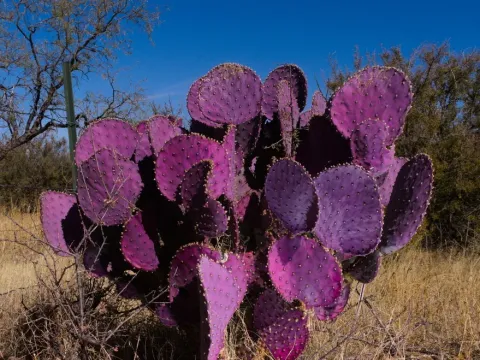
Opuntia
Opuntia
Opuntia, commonly known as prickly pear, is a genus in the Cactaceae family, known for its extreme resilience and ability to thrive in arid climates.
What the section contains
 Dillenius prickly pear
Opuntia dillenii (Ker Gawl.) Haw.
Dillenius prickly pear
Opuntia dillenii (Ker Gawl.) Haw.
 Durango prickly pear
Opuntia duranguensis Britton et Rose
Durango prickly pear
Opuntia duranguensis Britton et Rose
 Eastern prickly pear
Opuntia humifusa (Raf.) Raf.
Eastern prickly pear
Opuntia humifusa (Raf.) Raf.
 Indian fig opuntia
Opuntia megacantha Salm-Dyck
Indian fig opuntia
Opuntia megacantha Salm-Dyck
 Opuntia amyclaea
Opuntia amyclaea
Opuntia amyclaea
 Opuntia ficus-indica
 (L.) Mill.
Opuntia ficus-indica
Opuntia ficus-indica (L.) Mill.
 Opuntia heliabravoana
 Sheinvar
Opuntia heliabravoana
Opuntia heliabravoana Sheinvar
 Opuntia hyptiacantha
 F. A. C. Weber
Opuntia hyptiacantha
Opuntia hyptiacantha F. A. C. Weber
 Opuntia lasyacantha
 Pfeiffer
Opuntia lasyacantha
Opuntia lasyacantha Pfeiffer
 Opuntia matudae
 Sheinvar
Opuntia oligacantha
Opuntia oligacantha Sheinvar
Opuntia matudae
Opuntia matudae Sheinvar
Opuntia oligacantha
Opuntia oligacantha Sheinvar
 Opuntia robusta
 H. L. Wendl. ex Pfeiff.
Opuntia spinulifera
Opuntia spinulifera Salm-Dyck
Opuntia robusta
Opuntia robusta H. L. Wendl. ex Pfeiff.
Opuntia spinulifera
Opuntia spinulifera Salm-Dyck
 Opuntia streptacantha
 Lem.
Opuntia streptacantha
Opuntia streptacantha Lem.
 Orange prickly pear
Opuntia aurantiaca Lindl.
Orange prickly pear
Opuntia aurantiaca Lindl.
 White-haired prickly pear
Opuntia leucotricha DC.
White-haired prickly pear
Opuntia leucotricha DC.
 Xoconostle
Opuntia joconostle Weber
Xoconostle
Opuntia joconostle Weber
Opuntia
Cultivation is primarily achieved through vegetative propagation, using healthy, mature pads (cladodes) cut from established plants during the active growth phase.
These cuttings must be air-dried for several days in a shaded area to allow the wound to callus, preventing infection after planting in the soil.
In experimental or breeding programs, seeds are used, which require warm, well-aerated substrates and constant monitoring of moisture levels to germinate.
Spacing between plants is crucial for future maintenance, typically ranging from 2 to 4 meters between rows to allow for machinery access and plant growth.
Opuntia requires full sun exposure and performs best in regions with high solar radiation, which is essential for optimal fruit sugar content and growth.
The ideal soil is well-drained, sandy or loamy, with a neutral to slightly alkaline pH, ensuring that water never stagnates around the root system.
While extremely drought-tolerant, supplemental irrigation during the critical fruit-swelling stage significantly increases both the yield and the size of the fruit.
The plant is highly adaptable to temperature fluctuations but thrives best in warm conditions between 20°C and 35°C during the growing season.
It is sensitive to heavy, waterlogged soils which can lead to root rot; thus, planting on slight slopes or raised mounds is a recommended agricultural practice.
Productive Opuntia plantations can yield between 10 and 20 tons of fruit per hectare, depending on the specific cultivar, crop density, and irrigation management.
Plants generally reach peak production within 3 to 5 years after the initial planting of the cladodes, remaining productive for over two decades.
Fruit quality is assessed based on weight, uniform skin color, and internal sugar levels, which are critical for meeting commercial market standards.
Beyond the fruit, the cladodes are harvested for use as high-fiber, nutritious livestock feed, particularly during seasonal droughts when other forage is scarce.
Pruning is an essential management practice that removes damaged or aged segments, promoting air circulation and concentrating energy into fruit production.
Cactus bugs and cochineal scale are the most common pests that can infest the pads, leading to stunted growth and damage to the plant's structural integrity.
Fungal diseases like Phytophthora and Fusarium are primary threats, especially if the soil drainage is inadequate or if there is excessive humidity.
Weed control is necessary in the early years of establishment to ensure that young Opuntia plants do not compete with invasive grasses for nutrients.
Integrated pest management strategies, including the use of beneficial insects and targeted biological controls, are preferred over broad-spectrum chemical sprays.
Early identification of pest hotspots and the removal of infected plant segments are the most effective ways to prevent the spread of diseases across the field.
Harvesting Opuntia fruit is a labor-intensive process due to the presence of glochids, requiring handlers to wear thick, protective gear and use specialized tools.
Post-harvest processing involves brushing the fruit to remove remaining glochids, followed by grading based on color intensity and firmness.
Marketable fruit is stored in cold, dry environments to extend its shelf life, as it is highly perishable once removed from the parent plant.
The culinary applications of Opuntia are diverse, ranging from fresh consumption and juicing to the production of jams, syrups, and natural food colorings.
The versatility of the crop allows for dual-income streams: harvesting fruits for human consumption and harvesting cladodes for fodder or functional fiber production.