
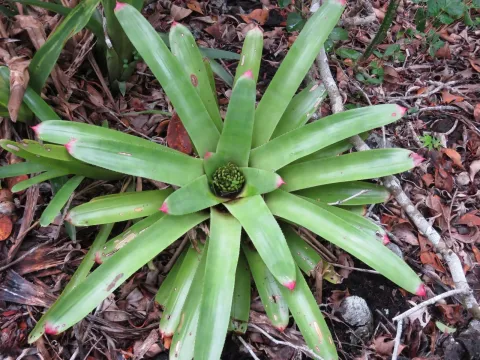
Neoregelia
Neoregelia L.B. Sm.
Neoregelia is a genus of flowering plants within the Bromeliaceae family. Originating from the tropical rainforests of South America, these epiphytes have evolved to grow on tree branches, where they capture moisture and nutrients through their central leaf rosettes, which function as biological tanks.
What the section contains
 Neoregelia carolinae
 (Beer) L. B. Sm.
Neoregelia carolinae
Neoregelia carolinae (Beer) L. B. Sm.
 Neoregelia carolinae and Neoregelia concentrica hybrids
Hybrids between Neoregelia carolinae and Neoregelia concentrica
Neoregelia carolinae and princeps hybrids
Hybrids between Neoregelia carolinae (Beer) L. B. Sm. and Neoregelia princeps (Baker) L. B. Sm.
Neoregelia carolinae and Neoregelia concentrica hybrids
Hybrids between Neoregelia carolinae and Neoregelia concentrica
Neoregelia carolinae and princeps hybrids
Hybrids between Neoregelia carolinae (Beer) L. B. Sm. and Neoregelia princeps (Baker) L. B. Sm.
 Neoregelia chlorosticta
 (Baker) L. B. Sm.
Neoregelia chlorosticta
Neoregelia chlorosticta (Baker) L. B. Sm.
 Neoregelia concentrica
 (Vell.) L. B. Sm.
Neoregelia concentrica and princeps hybrids
Hybrids between Neoregelia concentrica and Neoregelia princeps
Neoregelia concentrica
Neoregelia concentrica (Vell.) L. B. Sm.
Neoregelia concentrica and princeps hybrids
Hybrids between Neoregelia concentrica and Neoregelia princeps
 Neoregelia hybrids
Hybrids between Neoregelia carolinae and Neoregelia macrosepala
Neoregelia hybrids
Hybrids between Neoregelia carolinae and Neoregelia macrosepala
 Neoregelia macrosepala
 L. B. Sm.
Neoregelia macrosepala
Neoregelia macrosepala L. B. Sm.
 Neoregelia princeps
 (Baker) L. B. Sm.
Neoregelia princeps
Neoregelia princeps (Baker) L. B. Sm.
Neoregelia
To cultivate Neoregelia successfully, maintain an ambient temperature between 20°C and 25°C. These plants are sensitive to cold drafts and rapid temperature fluctuations, which can disrupt their metabolic processes and cause stress to the tropical foliage.
Light management is crucial for this crop. They thrive in bright, indirect light conditions. Sufficient light exposure is essential to trigger the development of the intense, vibrant coloration in the inner leaves, which is the primary ornamental characteristic of many Neoregelia species.
The growing medium must be highly porous and well-draining. A standard mix usually includes pine bark, peat moss, perlite, and charcoal. Because the roots are primarily for anchorage, they do not require a heavy or nutrient-dense soil, as the plant absorbs most nutrients through its central cup.
Watering practices involve filling the central tank with clean, room-temperature water. It is vital to flush and refresh this water periodically to prevent the accumulation of salts or debris. The potting medium should remain slightly moist but never waterlogged to ensure healthy root development.
The most common agricultural challenge for Neoregelia is root and crown rot, primarily caused by over-saturation of the substrate. If the soil remains soggy for extended periods, the root system loses its ability to breathe, leading to rapid decay of the plant tissue.
Scale insects are frequent pests that attach themselves to the foliage, especially on the undersides. These pests extract sap, weakening the plant and creating sticky honeydew that often attracts opportunistic fungal infections or sooty mold.
Spider mites are a significant threat in environments with low humidity levels. These tiny pests weave fine webs between the leaves and cause mottled, yellowing foliage. Increasing local humidity or utilizing horticultural oils is often necessary for control.
Mealybugs can cluster in the center of the rosette where access is difficult. They manifest as white, cotton-like masses and can stunt the growth of the plant if left untreated. Regular monitoring of the inner cup area is essential for early detection.
Effective pest management relies on keeping the environment clean and ensuring adequate airflow. Integrated pest management, including physical removal of insects and the use of targeted systemic treatments, is the standard approach for maintaining plant health in both home and greenhouse settings.