
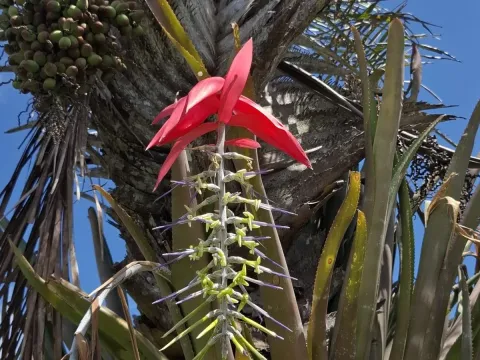
Billbergia
Billbergia
Billbergia is a genus of perennial flowering plants belonging to the Bromeliaceae family. These plants are widely recognized for their distinct rosette-forming habit and showy, often pendant inflorescences.
What the section contains
 Billbergia brasiliensis
Billbergia brasiliensis
Billbergia brasiliensis
 Billbergia chlorantha
Billbergia chlorantha
Billbergia chlorantha
 Billbergia decora
Billbergia decora
Billbergia decora
 Billbergia minarum
Billbergia minarum
Billbergia minarum
 Billbergia pohliana
Billbergia pohliana
Billbergia pohliana
 Billbergia pyramidalis
Billbergia pyramidalis
Billbergia pyramidalis
 Billbergia speciosa
Billbergia speciosa
Billbergia speciosa
 Billbergia viridiflora
Billbergia viridiflora
Billbergia viridiflora
 Billbergia windii
Billbergia windii
Billbergia windii
 Billbergia zebrina
Billbergia zebrina
Billbergia zebrina
Billbergia
Native to tropical forests in Central and South America, Billbergia species naturally grow as epiphytes on tree branches. Their biological structure is evolved to capture water and nutrients from the atmosphere and forest canopy debris.
To cultivate these plants successfully, one must provide bright, indirect sunlight. Direct exposure to the sun can damage the foliage, while insufficient light prevents the plant from producing its characteristic vibrant flowers.
The soil requirements focus on excellent drainage and aeration. A substrate mixture containing peat moss, pine bark, and perlite is ideal for mimicking the natural environment of an epiphyte and preventing root rot.
Temperature management is crucial, with the optimal range being 18-25 degrees Celsius. High humidity levels are preferred, which should be maintained throughout the growing season to support the plant's metabolic activity.
Mealybugs are among the most common pests that infest Billbergia. They congregate in the tight leaf axils, causing stunted growth and the production of honeydew, which can lead to sooty mold formation.
Scale insects frequently attach themselves to the stiff, leathery leaves. Regular monitoring and physical removal, or the application of horticultural oils, are effective management strategies for these pests.
Root rot is the primary physiological disorder caused by waterlogging. When the potting medium stays saturated for extended periods, the root system loses its ability to function, leading to plant decline.
Spider mites represent a threat during the drier winter months, especially when indoor air humidity drops significantly. Mites can cause yellowing and necrosis of the leaf surfaces if left untreated.
Fungal leaf spot diseases may appear if the plants are kept in stagnant, poorly ventilated conditions. Promoting good airflow is a vital cultural practice to minimize the incidence of these pathogens.