
Billbergia speciosa
Billbergia speciosa
Description
Growing requirements
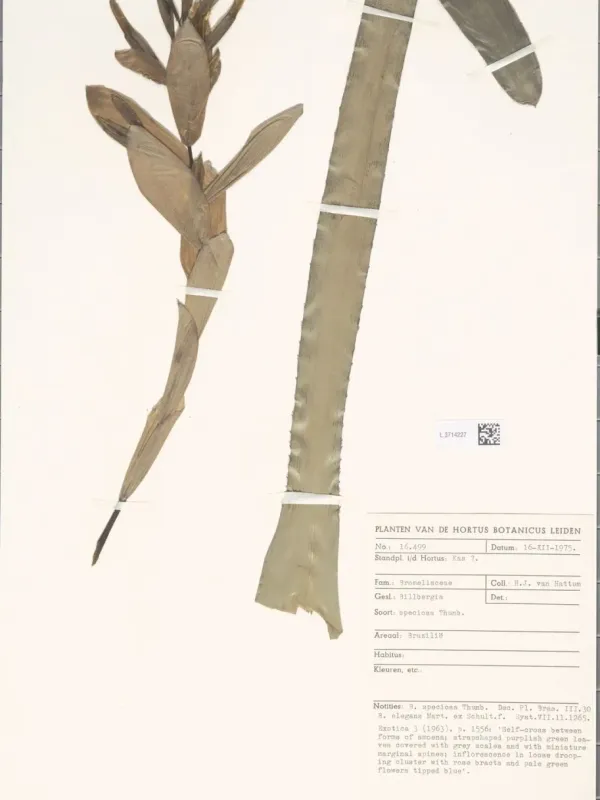
Billbergia speciosa, commonly known as the queen's tears or simply by its scientific name, is a member of the Bromeliaceae family. Native to the Atlantic Forest of Brazil, this species naturally occurs as an epiphyte, anchoring itself to trees or rocks in the forest understory.
Botanically, it is characterized by a funnel-like rosette of long, arching leaves with serrated edges. Its distinctive inflorescence consists of pendulous, rosy-pink bracts with blue-tipped petals, providing high ornamental value throughout the flowering season.
Optimal growth is achieved in bright, filtered light. While the plant can tolerate some shade, direct sunlight should be avoided to prevent foliar scorching. Maintaining a consistent temperature between 20°C and 25°C is ideal for vegetative growth.
The substrate must be well-draining and specifically designed for epiphytes, often consisting of a mix of bark, perlite, and peat moss. Proper aeration of the root system is vital to preventing asphyxiation of the delicate roots in a confined container.
Watering requires a two-fold approach: moisture in the potting medium and water within the central tank (rosette). Use only demineralized or filtered water to avoid salt buildup, and ensure the tank water is refreshed every few weeks to prevent stagnation.
Main diseases and pests
The primary pests affecting Billbergia speciosa include scale insects and mealybugs, which tend to hide in the tight crevices between the foliage, feeding on the plant's sap and weakening its structural integrity.
Fungal infections and root rot are common consequences of overwatering or poor drainage. These pathogens thrive in stagnant, soggy conditions, often leading to rapid tissue death starting from the base of the rosette.
Pest management should involve manual removal using alcohol-soaked swabs for light infestations, followed by the application of horticultural oils or systemic insecticides if the population remains persistent.
To mitigate disease risk, growers should ensure adequate air circulation around the plants. Avoiding overhead watering in cold, damp conditions helps reduce the incidence of fungal leaf spotting and decay.
Regular sanitation of the plant environment, including the removal of dead lower leaves, helps to eliminate potential breeding sites for pests and sources of fungal spores.