
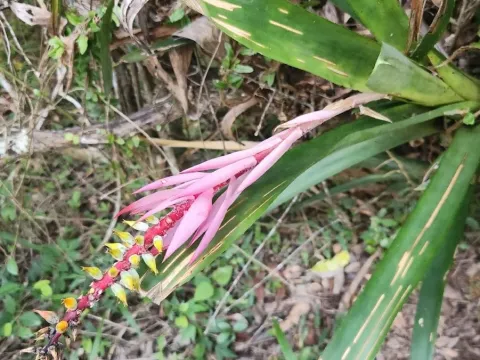
Aechmea
Aechmea Ruiz et Pav.
Aechmea is a genus of flowering plants in the Bromeliaceae family, native to the tropical forests of Central and South America. These plants are known for their rosette-forming foliage and long-lasting, vibrant inflorescences that make them highly valued in horticulture.
What the section contains
 Aechmea aquilega
 (Salisb.) Griseb.
Aechmea aquilega
Aechmea aquilega (Salisb.) Griseb.
 Aechmea blanchetiana
 (Baker) L. B. Sm.
Aechmea blanchetiana
Aechmea blanchetiana (Baker) L. B. Sm.
 Aechmea callichroma
 Read & Baensch
Aechmea callichroma
Aechmea callichroma Read & Baensch
 Aechmea calyculata
 (E. Morren) Baker
Aechmea calyculata
Aechmea calyculata (E. Morren) Baker
 Aechmea caudata
 Lindm.
Aechmea caudata
Aechmea caudata Lindm.
 Aechmea chantinii
 (Carrière) Baker
Aechmea chantinii
Aechmea chantinii (Carrière) Baker
 Aechmea chantinii x Aechmea tessmannii
Aechmea chantinii x Aechmea tessmannii
Aechmea chantinii x Aechmea tessmannii
 Aechmea coelestis
 (K. Koch) E. Morren
Aechmea coelestis
Aechmea coelestis (K. Koch) E. Morren
 Aechmea dichlamydea
Aechmea dichlamydea var. trinitensis
Aechmea dichlamydea Baker var. trinitensis L. B. Sm.
Aechmea dichlamydea x Aechmea fendleri
Aechmea dichlamydea x Aechmea fendleri
Aechmea dichlamydea
Aechmea dichlamydea
Aechmea dichlamydea var. trinitensis
Aechmea dichlamydea Baker var. trinitensis L. B. Sm.
Aechmea dichlamydea x Aechmea fendleri
Aechmea dichlamydea x Aechmea fendleri
 Aechmea distichantha
 Lem.
Aechmea distichantha
Aechmea distichantha Lem.
 Aechmea eurycorymbus
 Harms
Aechmea eurycorymbus
Aechmea eurycorymbus Harms
 Aechmea fasciata
 (Lindl.) Baker
Aechmea fasciata
Aechmea fasciata (Lindl.) Baker
 Aechmea fendleri
 Andre ex Mez
Aechmea fendleri
Aechmea fendleri Andre ex Mez
 Aechmea fosteriana
 L. B. Sm.
Aechmea fosteriana
Aechmea fosteriana L. B. Sm.
 Aechmea fulgens
 Brongn.
Aechmea hybrid
Aechmea dichlamydea x Aechmea fasciata
Aechmea fulgens
Aechmea fulgens Brongn.
Aechmea hybrid
Aechmea dichlamydea x Aechmea fasciata
 Aechmea hybrid
Hybrids between Aechmea eurycorymbus, Aechmea aquilega, Aechmea blanchetiana and Aechmea callichroma
Aechmea hybrid
Hybrids between Aechmea eurycorymbus, Aechmea aquilega, Aechmea blanchetiana and Aechmea callichroma
 Aechmea hybrid
Aechmea eurcarymbus x (Aechmea chantinii x Aechmea tessmannii)
Aechmea hybrid
Aechmea eurcarymbus x (Aechmea chantinii x Aechmea tessmannii)
 Aechmea lueddemanniana
 (K. Koch) Mez
Aechmea lueddemanniana
Aechmea lueddemanniana (K. Koch) Mez
 Aechmea magdalenae
 (André) André ex Baker
Aechmea magdalenae
Aechmea magdalenae (André) André ex Baker
 Aechmea nudicaulis
 (L.) Griseb.
Aechmea nudicaulis
Aechmea nudicaulis (L.) Griseb.
 Aechmea orlandiana
 L. B. Sm.
Aechmea orlandiana
Aechmea orlandiana L. B. Sm.
 Aechmea ramosa
 Mart. ex Schult. & Schult. f.
Aechmea ramosa
Aechmea ramosa Mart. ex Schult. & Schult. f.
 Aechmea recurvata
 (Klotzsch) L. B. Sm.
Aechmea recurvata
Aechmea recurvata (Klotzsch) L. B. Sm.
 Aechmea smithiorum
 Mez
Aechmea smithiorum
Aechmea smithiorum Mez
 Aechmea tessmannii
 Harms
Aechmea tessmannii
Aechmea tessmannii Harms
Aechmea
Botanically, most Aechmea species are epiphytes, meaning they grow on trees in their natural habitat. They absorb water and nutrients primarily through their central tank, formed by their stiff, often serrated, spine-tipped leaves.
Cultivation requires a well-draining, airy potting medium, such as a mix of peat, orchid bark, perlite, and charcoal. The pH levels should be slightly acidic to neutral to ensure optimal nutrient uptake by the roots.
Climate requirements include moderate to high temperatures, ideally between 20 °C and 25 °C. They thrive in bright, indirect light; harsh midday sun can scorch the foliage, while deep shade inhibits proper growth and flower development.
Water management is crucial: the central tank should be kept filled with clean, soft water during the growing season. It is vital to flush the tank periodically to prevent the accumulation of salts or stagnant debris.
Mealybugs and scale insects are the most common pests that affect Aechmea. They tend to hide in the crevices of the leaf rosette, where they feed on plant sap, necessitating prompt intervention with insecticidal soaps or systemic treatments.
Root rot is a major threat caused by overwatering or poor drainage. Once the root system is damaged, the plant loses its ability to uptake moisture, leading to overall decline and the yellowing of the leaves.
Fungal leaf spot diseases may occur in environments with low light and high humidity without sufficient air circulation. Keeping the foliage dry, except for the central tank, helps in preventing such infections.
Spider mites are prevalent in dry indoor environments. Regular misting and maintaining proper humidity levels help discourage these pests, while also promoting the overall health of the tropical foliage.
To ensure plant longevity, it is recommended to inspect the base of the rosette regularly for any signs of decay or pest infestation. Early detection is key to maintaining a healthy and thriving Aechmea collection.