
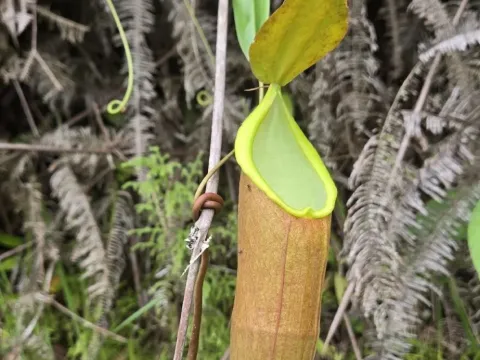
Nepenthes
Nepenthes L.
Nepenthes L., belonging to the Nepenthaceae family, is a genus of tropical carnivorous plants known for their specialized leaf-derived pitchers. These plants are native to diverse environments ranging from high-altitude cloud forests to lowland tropical swamps across Southeast Asia.
What the section contains
 Hybrid Nepenthes
hybrids between Nepenthes ampullaria Jack, Nepenthes sibuyanensis Nerz and Nepenthes ventricosa Blanco
Hybrid Nepenthes
hybrids between Nepenthes ampullaria Jack, Nepenthes sibuyanensis Nerz and Nepenthes ventricosa Blanco
 Khasia pitcher plant
Nepenthes khasiana Hook. f.
Khasia pitcher plant
Nepenthes khasiana Hook. f.
 Nepenthes alata
 Blanco
Nepenthes alata
Nepenthes alata Blanco
 Nepenthes ampullaria
 Jack
Nepenthes ampullaria
Nepenthes ampullaria Jack
 Nepenthes ampullaria x ventricosa
Hybrids between Nepenthes ampullaria and Nepenthes ventricosa
Nepenthes ampullaria x ventricosa
Hybrids between Nepenthes ampullaria and Nepenthes ventricosa
 Nepenthes lingulata
 Chi. C. Lee et al.
Nepenthes lingulata
Nepenthes lingulata Chi. C. Lee et al.
 Nepenthes lingulata x truncata
Nepenthes lingulata Chi. C. Lee et al. x Nepenthes truncata Macfarl.
Nepenthes lingulata x truncata
Nepenthes lingulata Chi. C. Lee et al. x Nepenthes truncata Macfarl.
 Nepenthes mira
 Jebb & Cheek
Nepenthes mira
Nepenthes mira Jebb & Cheek
 Nepenthes mira ventricosa
Nepenthes mira Jebb & Cheek x N. ventricosa Blanco
Nepenthes mira ventricosa
Nepenthes mira Jebb & Cheek x N. ventricosa Blanco
 Nepenthes rafflesiana
 Jack ex Hook. f.
Nepenthes rafflesiana x sibuyanensis
Nepenthes rafflesiana x Nepenthes sibuyanensis
Nepenthes rafflesiana
Nepenthes rafflesiana Jack ex Hook. f.
Nepenthes rafflesiana x sibuyanensis
Nepenthes rafflesiana x Nepenthes sibuyanensis
 Nepenthes sibuyanensis
 Nerz
Nepenthes sibuyanensis
Nepenthes sibuyanensis Nerz
 Nepenthes sibuyanensis x ampullaria hybrid
hybrids between Nepenthes sibuyanensis Nerz and Nepenthes ampullaria Jack
Nepenthes sibuyanensis x ampullaria hybrid
hybrids between Nepenthes sibuyanensis Nerz and Nepenthes ampullaria Jack
 Nepenthes truncata
 Macfarl.
Nepenthes truncata
Nepenthes truncata Macfarl.
 Nepenthes ventricosa
 Blanco
Nepenthes ventricosa
Nepenthes ventricosa Blanco
 Nepenthes ventricosa x vogelii hybrid
hybrids between Nepenthes ventricosa Blanco and Nepenthes vogelii Schuit. & de Vogel
Nepenthes ventricosa x vogelii hybrid
hybrids between Nepenthes ventricosa Blanco and Nepenthes vogelii Schuit. & de Vogel
 Nepenthes vogelii
 Schuit. & de Vogel
Nepenthes vogelii
Nepenthes vogelii Schuit. & de Vogel
Nepenthes
Climate control is the most demanding aspect of Nepenthes cultivation. High humidity levels, ideally between 70% and 90%, must be maintained to ensure the proper development of digestive pitchers. Temperatures should be regulated according to the species' origin, typically divided into highland and lowland categories.
The substrate must provide excellent drainage while maintaining a consistently moist, acidic environment. A mixture of long-fibered sphagnum moss, perlite, and bark is standard in professional production to prevent waterlogging and root asphyxiation, as these plants are extremely sensitive to mineral build-up.
Light intensity is crucial for the development of the traps and overall vigor. While they require bright, indirect light, exposure to direct, unfiltered sunlight can scorch the foliage and reduce the plant's ability to photosynthesize effectively.
Economic importance of Nepenthes is centered on the ornamental plant trade. Due to their unique biological structure and predatory nature, they are highly sought after by specialized plant collectors and botanical gardens for display purposes.
Pest management focuses primarily on controlling sucking insects such as mealybugs, aphids, and spider mites. These pests thrive in the high-humidity environments required by Nepenthes, making rigorous sanitation and early detection vital for crop health.
Root rot caused by stagnant water or the use of improper media is the leading cause of plant mortality. Implementing a strict watering schedule with high-quality, low-solute water is essential to prevent the accumulation of minerals that can lead to root degradation.