
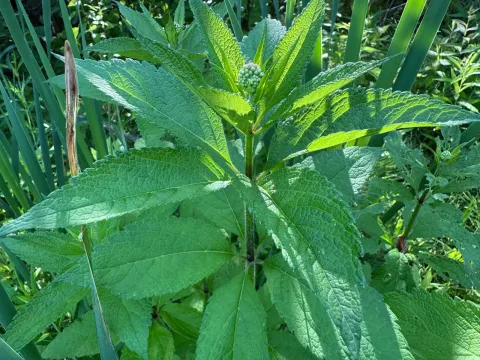
Spotted Joe-Pye weed
Eupatorium maculatum
Spotted Joe-Pye weed (Eupatorium maculatum) is a perennial herbaceous plant belonging to the Asteraceae family. It is characterized by its tall, sturdy stems that typically exhibit purple spots or streaks, which serves as a diagnostic feature.
What the section contains
Spotted Joe-Pye weed
The leaves are arranged in whorls along the stem and possess a lanceolate shape with serrated edges, contributing to its distinct appearance in the field.
During the flowering stage, the plant produces large, showy, corymb-like inflorescences consisting of numerous tiny pinkish-purple florets that attract pollinators.
It features a robust root system that allows for rapid vegetative spreading and high regeneration capacity, making it a persistent weed once established.
The seeds are equipped with tufts of hair (pappus), facilitating long-distance dispersal via wind and complicating efforts to prevent its spread in agricultural landscapes.
Spotted Joe-Pye weed thrives in moist environments, including riverbanks, wet meadows, marshes, and low-lying areas of agricultural fields that suffer from poor drainage.
In neglected farmlands, this species can rapidly colonize open spaces, often outcompeting native vegetation and forming dense, impenetrable stands.
The plant frequently invades fields where water accumulates, taking advantage of soil conditions that are typically unfavorable for standard crop development.
Its spread into productive areas is often linked to the movement of farm machinery that carries soil fragments containing root pieces from contaminated riparian zones.
Adaptability to varied moist soil types allows it to maintain presence in irrigation ditches and buffer zones, providing a continuous seed bank for field reinvasion.
The primary agricultural impact of Spotted Joe-Pye weed is its aggressive competition for essential nutrients, water, and sunlight, leading to significant yield losses in adjacent crops.
Because of its impressive height, the plant creates dense shade, which severely stunts the growth of crop seedlings and reduces the uniformity of the final stand.
In pastures or hay-producing lands, it is considered a nuisance weed that decreases forage quality and, in some cases, may pose toxicity risks if ingested by livestock.
Mechanical operations such as harvesting become difficult and inefficient when the weed is present, as its woody stems interfere with equipment components and can clog machinery.
The plant serves as a host for various insects and pathogens, increasing the risk of pest migration into the primary crop and necessitating additional chemical treatments.
Effective control requires a combination of deep tillage and plowing, which helps to disrupt and desiccate the extensive root network characteristic of this species.
Timely mowing or cutting of the foliage before seed set is crucial to prevent the replenishment of the soil seed bank and to weaken the overall vigor of the plant.
Implementing a rigorous crop rotation schedule that includes competitive cover crops can help shade out the weed and limit its ability to establish or recover.
- Systemic herbicide application post-harvest to kill the root system and prevent regrowth in the following season.
- Selective herbicide programs during the vegetative phase of the crop to minimize impact on the desired plant species.
- Improved drainage management to rectify soil moisture issues that make the environment favorable for Spotted Joe-Pye weed.
Comprehensive management strategies are essential, as the species is resilient and often requires a multi-year effort to achieve effective long-term suppression.