
Stemless Four-nerve Daisy
Tetraneuris scaposa
Description
How to tell it apart
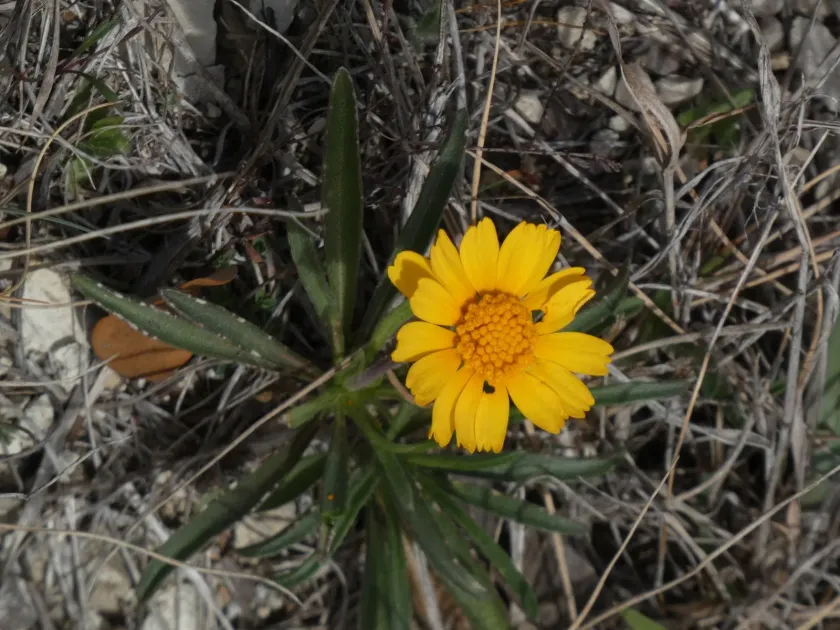
Tetraneuris scaposa, commonly known as Stemless Four-nerve Daisy, is a perennial herbaceous plant belonging to the Asteraceae family.
The plant is characterized by a basal rosette of narrow, hairy leaves and a long, leafless stalk topped with a bright yellow daisy-like flower.
Its root system is deep and taproot-based, allowing it to tap into moisture reserves far below the soil surface.
The leaves are often grey-green, which helps the plant reduce water loss through transpiration in arid environments.
Reproduction is primarily achieved through seeds, which are dispersed efficiently by the wind across open fields.
Where it grows
This weed is native to arid and semi-arid regions of North America, particularly thriving in dry, open grasslands.
In agricultural settings, it is frequently found in range lands, uncultivated margins, and abandoned pasture areas.
It prefers well-drained, limestone-based, or sandy soils where competition from dense vegetation is relatively low.
The plant is highly resilient to harsh conditions, including heat waves and prolonged droughts common in its natural range.
It often colonizes overgrazed pastures where the natural cover has been reduced, exposing the soil for seed germination.
Harm it causes
The primary agricultural harm is the degradation of pasture quality due to the crowding out of more palatable forage species.
It is considered toxic to livestock in some instances, containing compounds that can lead to health issues if ingested.
The deep taproot allows it to outcompete desirable crops for limited moisture and nutrients, especially during dry seasons.
Its persistence makes it a difficult weed to eradicate manually without significant disturbance to the surrounding soil.
Large infestations reduce the overall biomass yield, directly affecting the economic returns of grazing operations.
How to control
Preventive measures include maintaining healthy pasture cover, which limits the available space for weed seedling establishment.
Mechanical control through deep tilling can disrupt the taproot, although this is often not feasible on established pasture land.
Chemical control involves the application of systemic broadleaf herbicides, which are most effective when applied during active growth stages.
Mowing or grazing management that prevents the plant from setting seed can significantly reduce population expansion over time.
Integrating grazing management with targeted spot-spraying of herbicides is the most effective strategy for managing large areas.
Taxonomy
- Latin name
- Tetraneuris scaposa
- Family
- Сложноцветные (астровые)
- EPPO code
- TNUSC