
Spreading sneezeweed
Centipeda minima
Description
How to tell it apart
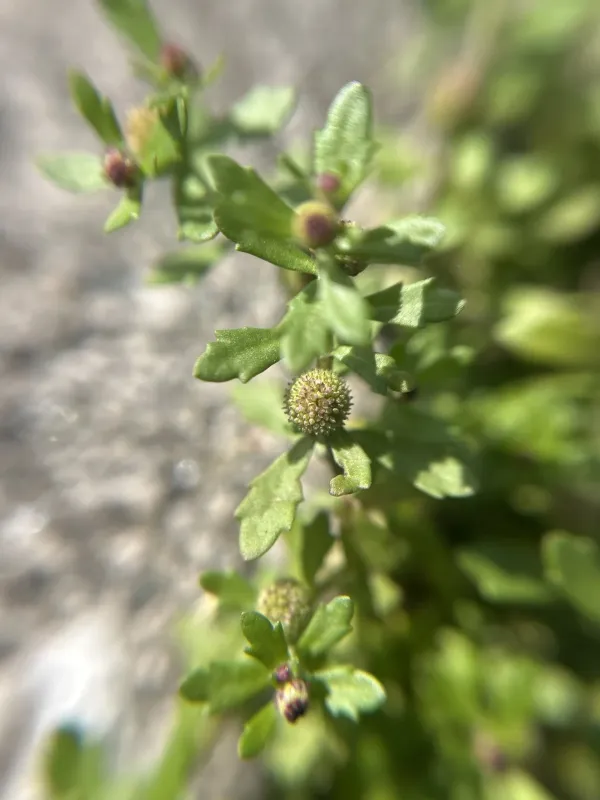
Centipeda minima, commonly known as spreading sneezeweed, is a small, prostrate annual herb belonging to the Asteraceae family. Its stems are highly branched and creep along the ground, often forming dense, low-growing mats.
The leaves are alternate, small, and typically obovate or spathulate in shape with serrated margins. The texture of the foliage ranges from glabrous to slightly pubescent, a feature that aids in water retention in varied environments.
The flowers of this plant are arranged in small, nearly sessile, globular heads located in the leaf axils. These distinct, yellow or greenish flower heads serve as the primary diagnostic feature for field identification.
The seeds are microscopic and equipped with structural features that facilitate dispersal via wind, water movement, or attachment to farm machinery, allowing for rapid colonization of new areas.
The root system is fibrous and shallow, enabling the weed to quickly uptake nutrients and moisture from the topsoil, which puts it in direct competition with the germinating seeds of agricultural crops.
Where it grows
Centipeda minima thrives in damp to wet environments. It is commonly found in rice paddies, along the banks of rivers and irrigation ditches, and on consistently moist, uncultivated land.
Agricultural fields that utilize intensive irrigation are particularly prone to infestations. The weed’s tolerance for periodic flooding makes it a persistent issue in paddy-based cropping systems worldwide.
Beyond cultivated fields, the plant often occupies gardens, damp orchard floors, and the margins of rural infrastructure, serving as a constant source of seed dispersal into nearby arable land.
It exhibits high ecological plasticity, allowing it to adapt to varying light conditions and soil types, provided that moisture levels remain sufficiently high to support its shallow root system.
The plant is frequently observed as a colonizer of disturbed sites, especially where water drainage is poor or where heavy machinery has compacted the soil, creating conditions favorable for its growth.
Harm it causes
The primary damage caused by Centipeda minima is its aggressive competition with crop seedlings for water, light, and soil nutrients during the early stages of crop development.
By forming dense, low-lying mats, the weed can restrict soil surface gas exchange and reduce soil temperature, which negatively impacts the root metabolism of the primary crop.
The weed acts as a host or micro-climate enhancer for various plant pathogens. The dense foliage maintains localized humidity levels that encourage fungal infections in the lower parts of crop plants.
There is evidence of potential allelopathic interference, where the plant releases biochemicals into the soil that inhibit the root growth and germination rates of neighboring crop species.
Furthermore, heavy infestations lead to significant yield losses and increase the difficulty and cost of mechanical harvesting, often resulting in high levels of weed seed contamination in the grain harvest.
How to control
Integrated weed management begins with proper crop rotation, which breaks the lifecycle of the weed by alternating between aquatic and terrestrial crops, thereby altering the soil moisture environment.
Mechanical control measures include deep plowing to bury weed seeds deep within the soil profile and timely inter-row cultivation before the weed reaches the flowering stage.
In paddy production, managing the water level is critical. Maintaining an appropriate standing water depth throughout the crop growth cycle is highly effective in suppressing the germination of many moisture-loving weeds.
Chemical control involves the application of selective post-emergence herbicides. Choosing the correct active ingredient is essential to ensure efficacy against the weed while maintaining crop safety.
- Regular maintenance of irrigation canals.
- Use of weed-free certified seeds.
- Manual removal for small-scale infestations.
- Strict monitoring of field edges for early detection.
Taxonomy
- Latin name
- Centipeda minima
- Family
- Сложноцветные (астровые)
- EPPO code
- CEPMI