
Stenotus armerioides
Stenotus armerioides
Description
How to tell it apart
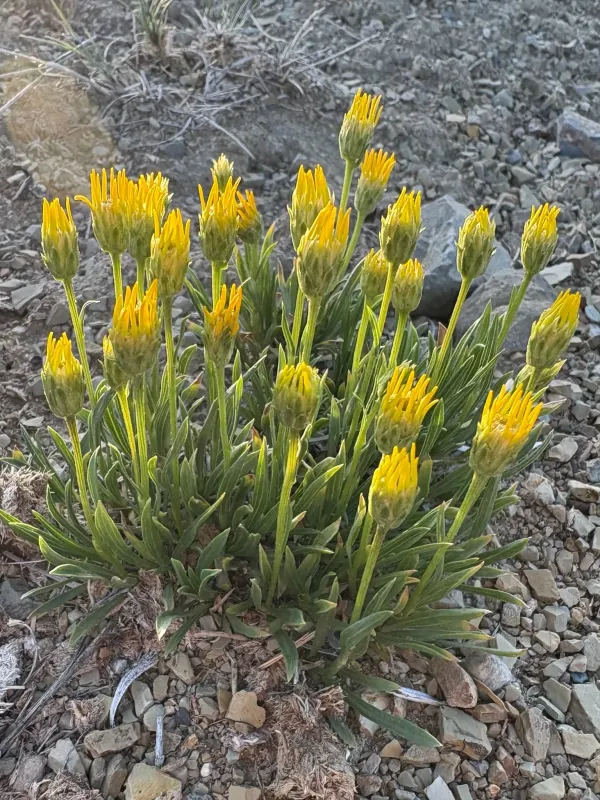
Stenotus armerioides, commonly known as thrift mock goldenweed, belongs to the Asteraceae family and grows as a dense, cushion-like perennial herb.
The plant is easily identified by its narrow, linear to spatulate leaves that form a dense basal rosette, which is highly reminiscent of the Armeria genus.
Flowering stems rise above the foliage, topped with single flower heads featuring bright yellow ray and disk florets, typical of the Asteraceae family.
It possesses a strong, deep-reaching taproot system, which allows the plant to thrive in dry environments and withstand significant periods of drought.
The fruits are achenes with a pappus, facilitating wind dispersal across open landscapes, which enables the weed to colonize new, disturbed habitats effectively.
Where it grows
This species is native to arid regions of North America, where it typically inhabits dry, rocky soils, hillsides, and outcrops of various geological formations.
In agricultural settings, Stenotus armerioides is frequently encountered on native rangelands and pastures located within semi-arid climatic zones.
The weed successfully colonizes degraded lands where the soil surface has been disturbed, reducing competition from desirable forage grasses.
It thrives in gravelly or rocky substrates where other species struggle to establish due to the severe lack of moisture and nutrients.
The extent of its infestation is usually correlated with grazing intensity and the overall health of the pasture ecosystem in the area.
Harm it causes
The primary agricultural impact of Stenotus armerioides is its ability to displace valuable forage species, thereby reducing total pasture productivity.
Due to its dense, tough, and often unpalatable foliage, the plant is typically avoided by livestock, making it an undesirable component of the grazing sward.
Stenotus competes aggressively with forage grasses and legumes for limited water and soil nutrients, depleting resources needed for productive vegetation.
As it expands its range in pastures, it occupies valuable space, preventing the natural regeneration of more nutritious plant species.
The presence of this weed requires costly management interventions to improve pasture quality and restore the balance of the forage stand.
How to control
Effective management begins with sustainable grazing practices to prevent overgrazing and protect the soil surface from unnecessary disturbance.
Mechanical control methods, such as selective removal of plants or inter-seeding with competitive forage varieties, can help minimize the weed's spread.
Chemical control involving systemic herbicides may be required, particularly for managing established patches of this perennial broadleaf weed.
- Implementing rotational grazing systems.
- Regular monitoring of pasture composition.
- Targeted application of approved selective herbicides.
- Improving soil health to favor desirable forage species.
All chemical interventions must adhere to safety guidelines to prevent environmental damage and ensure the protection of surrounding ecosystems.
Taxonomy
- Latin name
- Stenotus armerioides
- Family
- Сложноцветные (астровые)
- EPPO code
- ZTSAR