
Soliva nasturtiifolia
Soliva nasturtiifolia
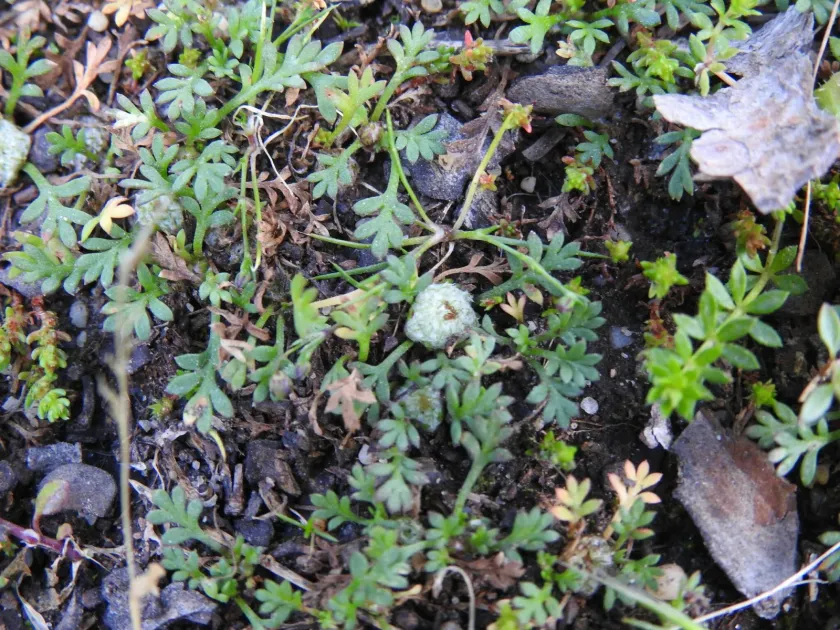
Description
How to tell it apart
Soliva nasturtiifolia is an annual herbaceous plant belonging to the Asteraceae family. It typically forms a low-growing, prostrate mat that spreads along the ground, characterized by deeply dissected, feathery leaves.
The stems are often extremely shortened or nearly absent, causing the leaf rosette to press tightly against the soil surface. The foliage shape is distinct and somewhat resembles that of nasturtium, which is the origin of its scientific name.
The flowers are very small, inconspicuous, and clustered in heads located in the leaf axils, often at ground level. This makes the weed very difficult to spot during its early vegetative stages.
The fruits are achenes, which often feature sharp, prickly spines upon maturity. These spikes become a significant nuisance, as they cause pain when stepped upon or when coming into contact with animal skin.
It possesses a fibrous, relatively shallow root system that allows it to rapidly colonize the upper soil profile, provided there is adequate moisture and favorable temperate conditions.
Where it grows
Native to South America, Soliva nasturtiifolia has successfully naturalized in many regions worldwide with temperate and subtropical climates, including parts of Australia, New Zealand, and the southern United States.
This weed prefers compacted or disturbed soil environments. It is frequently found in pastures, roadsides, parklands, and especially on managed turf and sports fields, where it competes aggressively with desirable grasses.
In agricultural settings, it is less common in tall-growing crops due to light competition, but it can establish dense patches in sparse crops or fields with poor ground cover.
The plant spreads primarily through seeds, which are easily transported by footwear, animal hooves, or agricultural machinery tires. Its high seed production ensures rapid colonization of new areas.
Given its invasive potential, it is closely monitored in many jurisdictions where it disrupts local ecosystems and managed green spaces.
Harm it causes
The primary concern with Soliva nasturtiifolia is its prickly fruit, which poses a physical threat to humans and animals. These spines can cause irritation and pain, limiting the recreational use of infested areas.
In grazing lands, this weed can outcompete nutritious forage species, reducing the overall carrying capacity of the pasture. Livestock often avoid grazing in areas heavily infested due to the risk of mouth and foot injury.
In agricultural production, the weed competes for vital resources such as water and nitrogen. While it is rarely a dominant weed in tall crops, it can reduce yields in low-growing or horticultural settings.
Its presence in high-value turf and sports fields leads to poor aesthetic quality and surface instability. The rosettes create gaps in the turf, which are difficult to repair without significant intervention.
The plant's ability to thrive under high-traffic and compacted conditions makes it a costly issue to manage for both municipal land managers and private farmers.
How to control
Cultural management strategies focus on maintaining a healthy, dense sward. A thick lawn or pasture canopy effectively shades out the emerging seedlings, preventing their establishment.
Mowing at regular intervals before the plant reaches the fruiting stage is a critical step in preventing seed set. Keeping the turf density high reduces the likelihood of colonization.
Chemical control is effective using selective broadleaf herbicides. Products containing 2,4-D, dicamba, or MCPA are commonly used to target the weed without harming the established turf grasses.
For small, localized infestations, spot treatment with non-selective herbicides like glyphosate may be necessary, though care must be taken to protect surrounding desirable vegetation.
Preventative measures include thorough cleaning of equipment and vehicles to remove soil and seed remnants, as well as managing the movement of fodder to prevent the introduction of new seeds.
Taxonomy
- Latin name
- Soliva nasturtiifolia
- Family
- Сложноцветные (астровые)
- EPPO code
- SOVNA