
Soliva sessilis
Soliva sessilis
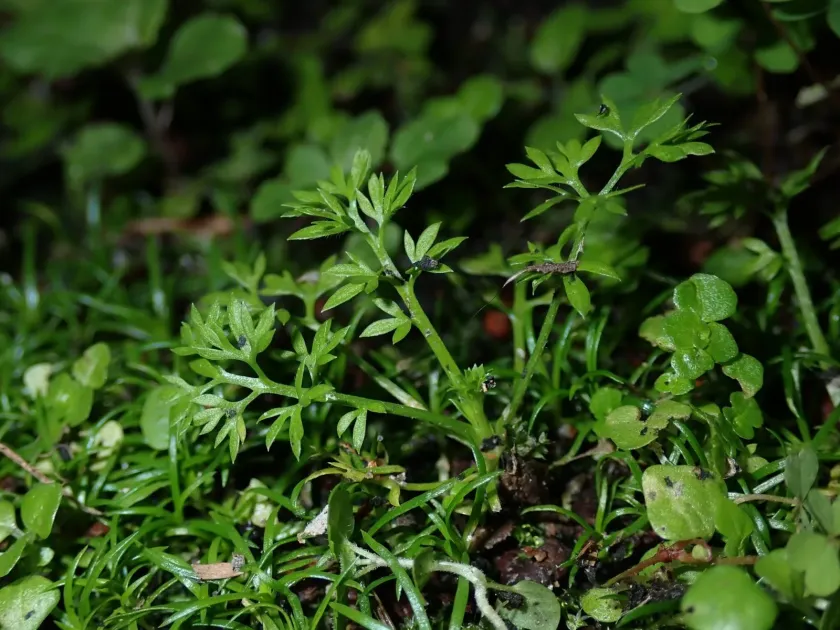
Description
How to tell it apart
Soliva sessilis, commonly known as field burweed, is a low-growing winter annual belonging to the Asteraceae family.
The plant is characterized by its finely divided, parsley-like foliage arranged in a compact rosette close to the ground.
It lacks a distinct stem, with the flower heads and subsequently the seed pods developing directly at the center of the base.
As the plant matures, the small, inconspicuous flowers give way to burrs that contain sharp spines, making the plant easily recognizable by touch.
The overall structure of the plant remains pressed against the soil surface, which is a key trait that helps it survive mowing.
Where it grows
This weed thrives in open, sunny locations with moist, disturbed, or compacted soil conditions.
It is frequently found in lawns, golf courses, athletic fields, and park areas where the turf is kept short.
Soliva sessilis is highly adaptable and can colonize various soil types, from sandy to clay-heavy, provided moisture is available.
Seed dispersal occurs mainly through the movement of the burrs, which attach to the fur of animals, footwear, and equipment.
In many regions, it is considered an invasive pest that rapidly establishes itself in urban landscapes and agricultural field margins.
Harm it causes
The primary concern regarding Soliva sessilis is the presence of sharp, stiff spines on the burrs that develop in late spring.
These burrs can easily pierce the skin of bare feet and the paws of pets, causing significant pain and irritation.
As an aggressive colonizer, it competes with desired turf grasses for nutrients, water, and space, leading to thinned lawn coverage.
Its growth pattern allows it to form dense patches that ruin the aesthetic appeal and playability of recreational grassy areas.
It effectively evades mechanical control measures like mowing, as its reproductive structures are located beneath the level of most mower blades.
How to control
Cultural control involves maintaining a healthy, dense turf through proper fertilization, aeration, and overseeding to crowd out the weeds.
Managing soil moisture and preventing compaction can reduce the likelihood of Soliva sessilis taking hold in a lawn or field.
Chemical control is most effective when performed using selective broadleaf herbicides before the development of the prickly burrs.
- Applying herbicides containing 2,4-D or dicamba during the early growing season.
- Targeting spots with high infestations rather than blanket spraying when possible.
- Timing the applications according to the specific growth stage of the plant.
Small infestations can be managed by hand-pulling, ensuring that the entire root system is removed before the seeds mature.
Taxonomy
- Latin name
- Soliva sessilis
- Family
- Сложноцветные (астровые)
- EPPO code
- SOVSE