
Southern marigold
Tagetes minuta
Description
How to tell it apart
Southern marigold (Tagetes minuta) is an annual herbaceous plant belonging to the Asteraceae family. It is known for its rapid growth, capable of reaching heights of up to 2 meters.
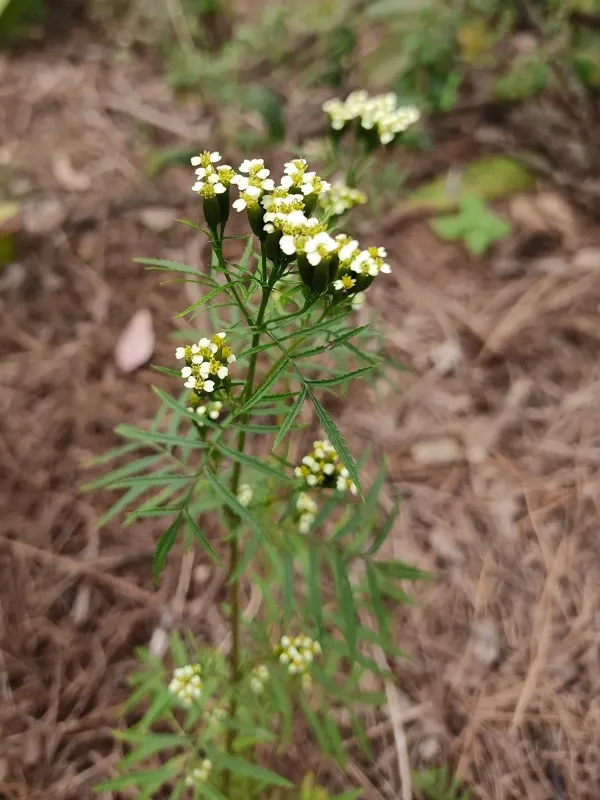
The stem is erect, striated, and highly branched in the upper parts, often appearing bare but covered in glandular structures that release a strong, distinctive aroma.
Leaves are pinnately dissected, consisting of linear-lanceolate leaflets with finely serrated margins, which serve as a primary identification characteristic.
Flowers are arranged in small, dense, paniculate clusters. Unlike ornamental marigolds, the flower heads are pale yellow and relatively inconspicuous.
The plant produces numerous tiny, dark-colored seeds equipped with a pappus, allowing for efficient long-distance dispersal via wind.
Where it grows
Native to South America, Tagetes minuta has become naturalized in many tropical and subtropical regions across the globe due to its high ecological adaptability.
It favors sunny environments with well-drained, fertile soils, frequently colonizing roadsides, fallow fields, and neglected agricultural land.
The species poses a significant threat to row crops like maize, soybeans, and vegetables, especially in regions with high irrigation and light exposure.
Its ability to thrive in diverse soil conditions makes it a formidable invasive competitor in modern agricultural systems.
It is often introduced into new areas through agricultural machinery or movement of contaminated soil and harvesting equipment.
Harm it causes
The primary impact of Tagetes minuta is intense competition with crops for essential resources such as water, nutrients, and sunlight.
Its rapid canopy development creates heavy shading, which significantly suppresses the growth of cultivated plants and reduces overall yield.
Research indicates that Southern marigold exhibits allelopathic properties, releasing compounds into the soil that inhibit the root growth of nearby crops.
The plant serves as an alternate host for various soil-borne nematodes and pathogens, which can exacerbate disease pressure in subsequent crops.
Large weed infestations increase harvesting costs and reduce harvest quality by clogging machinery and increasing the moisture content of the grain heap.
How to control
Integrated weed management must prioritize crop rotation to prevent the accumulation of the soil seed bank, which can remain viable for several seasons.
Pre-seeding cultivation is essential to eliminate seedlings during the early growth stages, preventing the establishment of a competitive weed population.
Chemical control involving selective herbicides is effective, provided they are applied during the sensitive early growth stages of the weed.
- Application of post-emergence herbicides for broadleaf weed control.
- Use of soil-applied herbicides to provide residual protection in row crops.
- Timely mechanical inter-row cultivation to disrupt root systems before flowering.
Sanitation of field borders and irrigation channels is crucial to prevent re-infestation from peripheral areas where the weed often establishes first.
Taxonomy
- Latin name
- Tagetes minuta
- Family
- Сложноцветные (астровые)
- EPPO code
- TAGMI