
Spring evax
Evax verna
Description
How to tell it apart
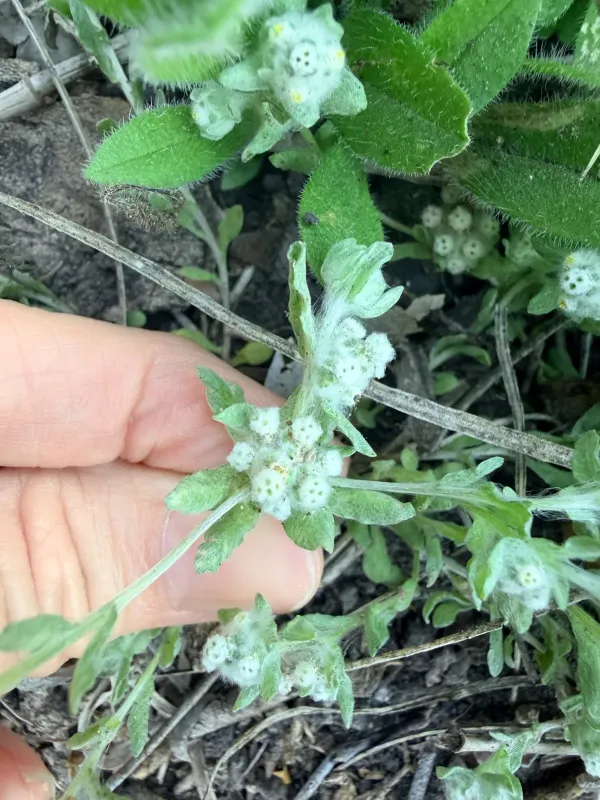
Spring evax (Evax verna) is an annual herbaceous plant belonging to the Asteraceae family. Visually, it is a low-growing plant, typically reaching only 5–10 cm in height, covered with dense grayish hairs that give it a woolly or felt-like appearance.
The stem is either simple or branched at the base. The leaves are alternate, linear-lanceolate or spatulate, and entire, often pressed close to the stem, which is an adaptation for moisture conservation in arid conditions.
The flower heads of the Spring evax are very small and arranged in dense clusters, often surrounded by bracts that form a rosette-like structure. The root system consists of a taproot, which is relatively weak.
The flowering period occurs during the spring months, as the name implies. The fruits are tiny achenes that are easily dispersed by wind, ensuring the rapid spread of the species into new areas.
The main identifying feature is its compact habit combined with the characteristic gray pubescence, making it relatively easy to distinguish from other common weeds during the early stages of vegetation.
Where it grows
Spring evax is a typical representative of the Mediterranean flora, found primarily in the southern regions of Europe. It prefers dry, sandy, and stony soils where competition from other plant species is minimal.
In agricultural practice, this species is most often found in winter crop fields, where it manages to complete its primary development cycle before the peak competition period with cultivated plants for nutrients and moisture.
It favors open, sun-warmed areas and often colonizes field margins, roadsides, and abandoned lands, from which seeds easily spread to cultivated fields through wind or agricultural machinery.
The plant shows high ecological plasticity regarding saline or extremely nutrient-poor soils, making it a dangerous competitor for early cereal crops in regions with limited rainfall.
Due to its early growth, Spring evax successfully occupies available niches in fields that have not yet reached canopy closure, creating favorable conditions for its propagation and colonization of larger areas.
Harm it causes
The harm caused by Spring evax lies primarily in its ability to consume available moisture from the topsoil layer during the intensive growth phase of winter crops, which is critical for spring harvest formation.
Although the weed does not reach significant sizes, its high density in fields leads to substantial competition for mineral nutrients, especially nitrogen, which is essential for crop plants at the beginning of the season.
In cases of mass infestation, Spring evax can significantly slow the development of young cereal shoots, leading to uneven crop ripening, reduced overall yield, and degradation of grain market quality.
The presence of this weed complicates agricultural operations and facilitates the spread of diseases, as the dense mats create localized high humidity, which promotes the development of fungal infections.
Furthermore, seeds of this weed can contaminate seed stocks, requiring additional costly cleaning and calibration processes after harvest, which increases the production cost of the final commodity.
How to control
Effective control of Spring evax begins with proper primary tillage, including deep plowing, which prevents seed germination from deeper soil layers and destroys already established plant rosettes.
A crucial agrotechnical method involves crop rotation with competitive species that quickly cover the soil, suppressing weed growth by depriving them of light and space.
The application of chemical crop protection products should be carried out during the early vegetation phase of the weed, as it is most vulnerable to systemic or selective herbicides during this period.
Regular field monitoring is recommended, especially along field edges, to detect infestation spots early and perform spot treatments, preventing mass seed production across the entire field.
Using high-quality, certified, and cleaned seed material is a mandatory requirement to prevent the introduction of Spring evax into clean fields, representing the most economically viable long-term strategy.
Taxonomy
- Latin name
- Evax verna
- Family
- Сложноцветные (астровые)
- EPPO code
- EVAMU