
Soliva stolonifera
Soliva stolonifera
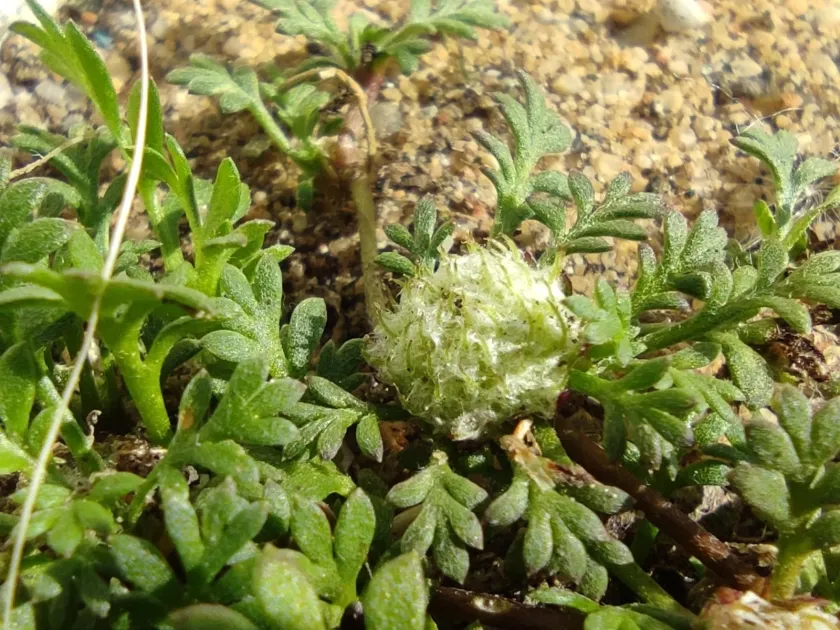
Description
How to tell it apart
Soliva stolonifera, commonly known as common soliva or lawn burweed, belongs to the Asteraceae family. It is a low-growing, prostrate herbaceous plant that spreads through stolons.
The leaves are finely dissected and feathery, arranged in rosettes that lie flat against the soil surface. This morphology allows the weed to thrive even under heavy foot traffic.
Flowering occurs in the leaf axils near the ground, producing tiny, inconspicuous greenish-yellow flower heads that are often overlooked by observers.
The root system is shallow but fibrous, anchoring the plant firmly while allowing it to spread efficiently across lawn surfaces or field gaps.
The most distinctive feature is the seed pods, which develop sharp, spine-like appendages. These spines are designed for dispersal by attaching to the fur of animals or the footwear of humans.
Where it grows
Soliva stolonifera is widely adapted to temperate and subtropical climates. It thrives in open, sunny locations with adequate moisture, such as pastures, parklands, and golf courses.
It is particularly problematic in residential lawns where the height of the turf is kept low, as the weed easily outcompetes struggling grasses under these conditions.
In agricultural settings, it frequently invades perennial forage crops, especially in areas where soil coverage is incomplete or grazing is overly intensive.
The plant demonstrates a strong preference for fertile soils but is sufficiently resilient to establish in compacted areas where other plant competition is low.
It acts as an invasive species in many parts of the world, often introduced through contaminated equipment or animal migration patterns.
Harm it causes
The primary harm caused by Soliva stolonifera is its ability to outcompete desired plant species for water, sunlight, and nutrients, leading to reduced overall pasture productivity.
In turf management, the plant is a nuisance because its sharp seed pods can cause painful injury to human feet and pets, effectively rendering lawns unusable during certain times of the year.
The weed degrades the quality of forage, as livestock tend to avoid grazing on the dense mats of soliva due to its texture and the irritation caused by its seeds.
Its ability to withstand frequent mowing makes it a dominant species, effectively displacing desirable turfgrasses and creating patchy, unappealing landscape aesthetics.
Due to its high seed set and rapid vegetative growth, it can quickly transform from a small cluster into an extensive infestation, requiring persistent management.
How to control
Cultural control is vital and includes promoting dense, healthy turf through proper fertilization, aeration, and maintaining a slightly taller mowing height to shade out the rosettes.
Hand-pulling is feasible for small, early-stage infestations; however, care must be taken to remove the entire stoloniferous root system to prevent rapid re-establishment.
Chemical control involving selective broadleaf herbicides (e.g., 2,4-D or dicamba) is most effective when applied in late autumn or early spring before the plant sets seeds.
Application timing is critical; treating the weed after it has produced its sharp spines significantly reduces the success rate of the control measures.
- Regular monitoring of high-traffic areas for initial outbreaks.
- Overseeding of bare patches to prevent weed establishment.
- Strategic use of post-emergent herbicides in accordance with local environmental regulations.
Taxonomy
- Latin name
- Soliva stolonifera
- Family
- Сложноцветные (астровые)
- EPPO code
- SOVST