
Description
How to tell it apart
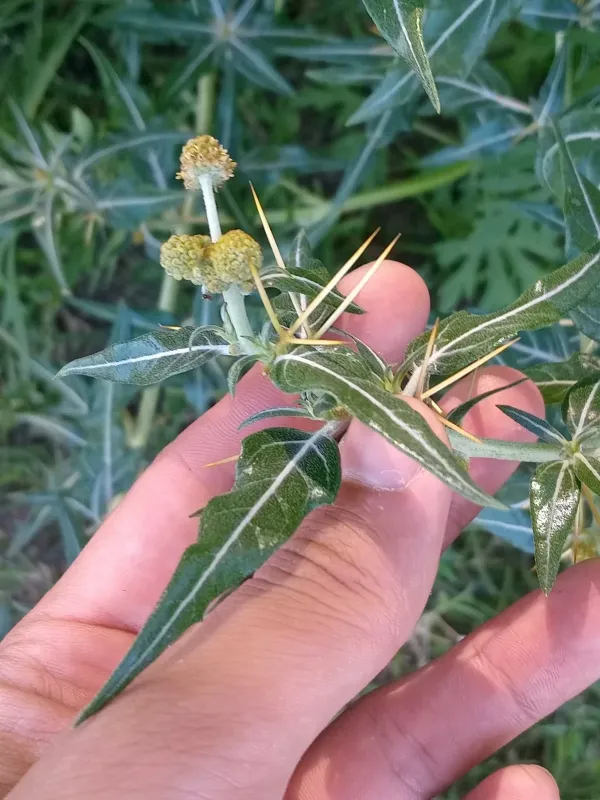
Spiny cocklebur (Xanthium spinosum) is an annual herbaceous weed belonging to the Asteraceae family. It is easily identified by the presence of long, yellow, three-forked spines located at the leaf axils.
The plant features a branching stem that can grow up to 80 cm in height. The leaves are lance-shaped or trilobed, with a dark green upper surface and a distinct white, felt-like lower surface.
The flowers are clustered in small heads, eventually developing into hard, burr-like fruits covered in hooked spines. These burrs are highly efficient at clinging to animal fur and clothing.
The root system is a deep taproot, which allows the plant to thrive in dry conditions and withstand competitive environments where soil moisture is limited.
Spiny cocklebur is a prolific seed producer. The seeds are enclosed within the burr, protecting them and facilitating long-distance dispersal via mammals and human activity.
Where it grows
This weed typically colonizes open areas, wastelands, roadsides, and disturbed soils. It is frequently found in agricultural fields, particularly in row crops like corn and soy.
It prefers sunny environments and is highly adaptable to various soil types, provided there is enough space for its relatively deep root system to develop.
Pastures and grazing lands are common sites for infestation, where the weed takes advantage of areas cleared of native vegetation or overgrazed patches.
The plant has expanded its range globally, often hitching rides on livestock or in contaminated agricultural produce, making it a common sight in temperate and warm climates.
Disturbed ground along irrigation ditches and field edges serves as a reservoir for populations, which then spread into the main cropping areas.
Harm it causes
Spiny cocklebur is a highly competitive weed, consuming significant amounts of water and nitrogen, which leads to reduced biomass and yield in crop plants.
The hooked burrs are notorious for damaging wool quality in sheep, rendering the product less valuable and creating significant management issues for livestock farmers.
The plant contains toxic glycosides and can be poisonous to cattle, horses, and pigs if ingested in sufficient quantities, causing severe digestive irritation or worse.
It acts as a host for various insects and plant pathogens, which can subsequently migrate to adjacent crops, increasing the risk of disease and pest outbreaks.
Its spines make manual weeding dangerous and difficult, increasing operational costs for farmers and posing a physical risk to workers in the fields.
How to control
Effective control starts with cultural practices such as deep tillage before planting, which buries seeds and kills early-emerging seedlings before they establish.
Maintaining a strict crop rotation and using cover crops can help suppress Spiny cocklebur by outcompeting it for sunlight and soil nutrients during the early season.
Chemical control involving post-emergence selective herbicides is often necessary when infestations are high. Treatments should be timed early to prevent seed set.
Regular mowing of field margins and non-cropped areas prevents the plant from maturing and producing the characteristic burrs, thereby limiting the seed bank.
- Deep plowing to bury the seeds
- Early inter-row cultivation
- Targeted application of systemic herbicides
- Sanitation of equipment to prevent seed spread
Content graph
Connections · Spiny cocklebur
Most often together:
Marketplace
Products · 2

Gerber
Superus Co., Ltd., Китай, Yangzhou Pioneer Chemical Co., Ltd., Китай
Herbicides
0
0
·
1.9K
No offers
—
Details
Biology
Taxonomy
- Latin name
- Xanthium spinosum
- Family
- Сложноцветные (астровые)
- EPPO code
- XANSP