
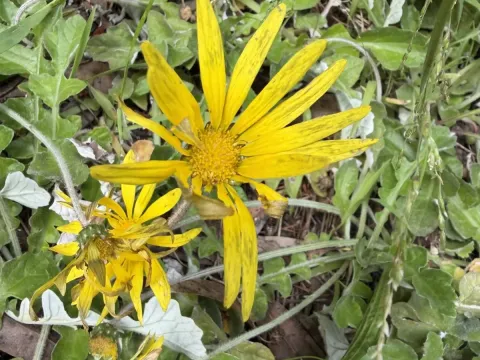
Arctotheca prostrata
Arctotheca prostrata
Arctotheca prostrata is a perennial herbaceous plant belonging to the Asteraceae family. It is characterized by a prostrate growth habit, forming dense, low-growing mats that can easily cover soil surfaces.
What the section contains
Arctotheca prostrata
The leaves are pinnately lobed and possess a diagnostic feature: a dense, white, felt-like tomentum on the underside, which provides a useful visual identifier for field scouting.
The inflorescences consist of typical yellow daisy-like flower heads. While they resemble other members of the Arctotis genus, Arctotheca prostrata is distinguished by its aggressive creeping stems that root at the nodes.
Its root system is fibrous and highly branched, with stolons that anchor firmly into the substrate, allowing the plant to sustain rapid vegetative spread even under stressful conditions.
The plant demonstrates significant resilience to physical disturbance, making it a difficult weed to eradicate once it has established a foothold in an agricultural environment.
Native to Southern Africa, this species has become a widespread invasive weed in regions with Mediterranean-type climates, including California, Australia, and parts of Europe.
Arctotheca prostrata thrives in disturbed areas such as roadsides, fallow fields, and orchard margins, often outcompeting native or desirable vegetation for space and resources.
In cultivated areas, it frequently invades vineyards, orchards, and gardens, where its carpet-like growth habit poses a challenge to soil management and crop productivity.
It is remarkably adaptable to various soil types, ranging from sandy to saline, and can withstand periods of drought, which facilitates its spread in diverse ecological zones.
The weed spreads effectively via both seeds and stem fragments, often transported across fields by agricultural machinery during routine cultivation and harvesting operations.
The primary economic impact is its severe competition with crops for water, nutrients, and sunlight, which often leads to significant yield losses in infested fields.
The dense mats formed by this weed create a barrier that inhibits crop seedling emergence and makes mechanical weeding or cultivation between rows difficult and labor-intensive.
It may serve as an alternative host for various agricultural pests and pathogens, potentially increasing the disease pressure on the primary crops grown in the vicinity.
In pasture systems, Arctotheca prostrata is considered an undesirable species because it provides poor forage quality for livestock and rapidly displaces more nutritious grasses.
The ongoing cost of managing and controlling this invasive species reduces the overall profitability of agricultural enterprises in affected regions.
Mechanical control involves thorough deep plowing followed by multiple passes of cultivation to expose and desiccate the stolons, preventing regrowth from plant fragments.
Adopting competitive crop rotations can help suppress the weed, as vigorous crops with canopy cover limit the light availability required for the rapid growth of the weed.
Chemical control focuses on the application of systemic herbicides during the plant's active growth stage, ensuring the active ingredients are translocated into the rooting system.
- Use of glyphosate-based herbicides for spot treatment or edge management.
- Application of selective herbicides registered for specific crops to manage infestation levels.
- Follow-up treatments are essential to manage sprouts arising from any remaining dormant nodes.
An integrated pest management (IPM) approach that combines sanitation, timely mechanical cultivation, and appropriate herbicide usage is necessary for long-term suppression of this weed.