
Ash-coloured fleabane
Cyanthillium cinereum
Description
How to tell it apart
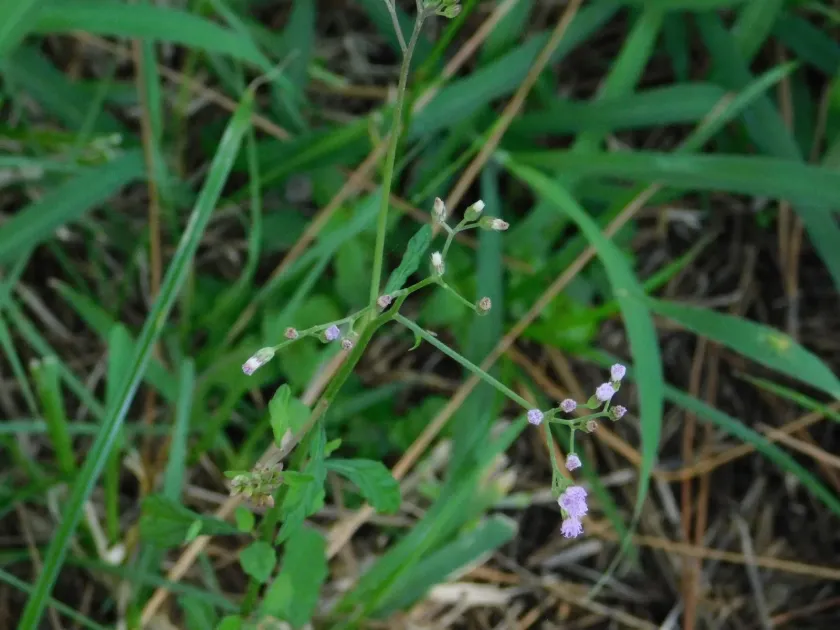
Ash-coloured fleabane (Cyanthillium cinereum) belongs to the Asteraceae family. It is an annual herbaceous plant with an upright or branched stem, typically reaching heights of 20 to 80 cm.
The leaves are alternate, ovate or elliptical in shape, with slightly serrated margins. A key identification feature is the dense, whitish-grey hair on the underside of the leaves, which inspired the common name.
The inflorescences are small flower heads arranged in loose corymbs. The tubular florets within the heads exhibit characteristic pink-purple or lilac hues.
The seeds (achenes) are equipped with a pappus, which allows them to be easily dispersed by the wind over long distances, facilitating the rapid colonization of new areas.
It possesses a deep taproot system, enabling the plant to withstand periods of low rainfall and compete effectively with crop plants for water and essential soil nutrients.
Where it grows
This weed prefers open, sunny environments. It is widely distributed in tropical and subtropical regions, frequently found in abandoned fields, pastures, and along roadsides.
In modern agriculture, Ash-coloured fleabane is a significant issue in vegetable plots, grain fields, and commercial industrial crop plantations.
The plant demonstrates high adaptability to various soil types but thrives best in loose, moist, and well-lit environments where competition from other plants is low.
It harms crops primarily during the early stages of development, as its fast growth rate allows it to quickly occupy space and shade out the newly emerged seedlings.
Inadequate farming practices, such as lack of proper row maintenance and failure to implement crop rotation, significantly increase the risk of infestation.
Harm it causes
The weed’s primary harmful impact is its high competitive ability for water, nutrients, and sunlight, which are vital for the healthy development of agricultural crops.
Due to its rapid growth and early-season vigor, Ash-coloured fleabane can significantly reduce overall crop yields by suppressing growth during critical physiological phases.
The plant acts as an alternative host for various agricultural pests and pathogens, increasing the risk of disease spread within the main crop stands.
Heavy infestations make harvesting difficult and decrease the quality of the harvested produce due to the contamination of seeds and foreign botanical matter.
The prolific seed production allows the weed to quickly build up a persistent seed bank in the soil, complicating long-term management efforts on affected lands.
How to control
The primary control method involves thorough mechanical tillage: deep plowing and timely disking help destroy seedlings and deplete the weed’s soil seed reserves.
Effective agrotechnical measures include strict crop rotation, utilizing crops with high canopy density to naturally shade out the weeds and suppress their emergence.
Regular cultivation of rows is essential before the crop canopy closes, effectively starving the weed of light and physical space needed for development.
In cases of severe infestation, the use of registered herbicides, chosen specifically for the cultivated crop and weed growth stage, is necessary for effective management.
- Utilizing competitive cover crops in rotation.
- Timely mowing to prevent seed production before flowering.
- Strategic use of post-emergence chemical control.
- Keeping agricultural machinery clean to prevent seed spread.
Taxonomy
- Latin name
- Cyanthillium cinereum
- Family
- Сложноцветные (астровые)
- EPPO code
- VENCI