
Austrian chamomile
Cota austriaca
Description
How to tell it apart
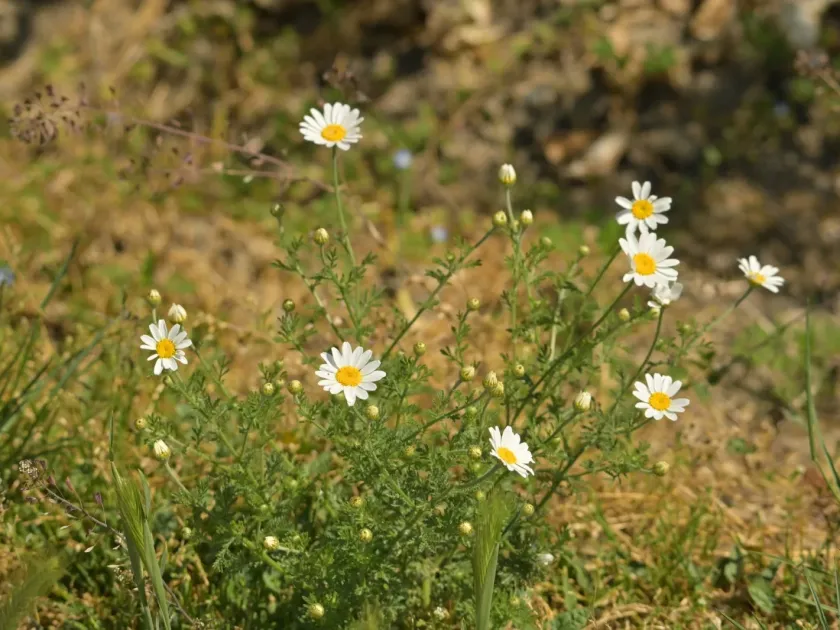
Austrian chamomile (Cota austriaca) belongs to the Asteraceae family. It is an herbaceous plant that grows with erect, branched stems, often reaching heights of up to 50 cm.
The leaves are finely dissected into narrow segments, giving them a fern-like, feathery appearance, and are covered with fine hairs that provide a grayish-green color.
Its flowers are typical daisy-like heads, featuring white ray florets and yellow disk florets, which are highly attractive to various pollinators.
The root system is a robust taproot, which allows the plant to access deep water reservoirs and nutrients, making it highly competitive in dry environments.
The plant reproduces via seeds, which are produced in large quantities and can remain viable in the soil for several years before germinating.
Where it grows
This species thrives in open, sunny locations, commonly colonizing agricultural fields, roadsides, waste areas, and dry, open grasslands across steppe regions.
It is frequently found as a major weed in winter and spring cereal crops, where it exploits the lack of initial competition to establish a dense population.
It prefers well-drained, sandy or loamy soils and is particularly resilient to drought conditions, often outcompeting crops that are under moisture stress.
Distribution is primarily facilitated by human activity, particularly the movement of farm machinery and the use of contaminated crop seeds during planting.
It is an opportunistic colonizer, rapidly infesting fields where soil management practices, such as tillage or crop rotation, have been neglected or poorly executed.
Harm it causes
The primary damage caused by Austrian chamomile is its intense competition for water and soil nutrients, which can significantly stunt the growth of nearby cereal crops.
The dense vegetative growth shades developing crop plants during their critical early growth stages, leading to reduced photosynthetic efficiency and biomass accumulation.
During harvesting, the tough, fibrous stems of the plant interfere with machinery, clogging combines and significantly increasing the moisture content of the harvested grain.
Seed contamination of the grain harvest reduces the final market value of the crop, necessitating intensive cleaning processes that add to operational costs.
Allelopathic effects have been observed, where root exudates from the plant may inhibit the germination and early development of neighboring agricultural plants.
How to control
Mechanical control through deep autumn plowing is highly effective, as it buries seeds to depths where they are unable to germinate successfully.
Implementing a diverse crop rotation is essential, as it disrupts the growth cycle of the weed and allows for the introduction of inter-row cultivation in row crops.
Chemical control involving selective herbicides targeting broadleaf weeds is a standard practice, with applications ideally performed at the rosette stage for maximum efficiency.
Managing non-crop areas, such as field borders and irrigation ditches, is crucial to prevent the spread of seeds into the cultivated fields throughout the growing season.
- Use high-quality, certified seed for planting.
- Perform timely harrowing to eliminate young weed seedlings.
- Ensure chemical applications are timed correctly based on growth stage.
- Maintain proper field sanitation to reduce the overall weed seed bank.
Taxonomy
- Latin name
- Cota austriaca
- Family
- Сложноцветные (астровые)
- EPPO code
- ANTAU