
Annual marshelder
Iva annua
Description
How to tell it apart
Annual marshelder (Iva annua) is an annual herbaceous plant belonging to the Asteraceae family. It typically develops an erect, branched stem that can reach heights ranging from 30 to 150 centimeters.
The leaves are opposite, ovate to lanceolate in shape, with serrated margins and a characteristic rough, hairy texture. The stem itself is also covered in stiff hairs, giving the plant a distinct grayish-green appearance.
Its root system is a robust taproot that penetrates deep into the soil profile, providing the plant with excellent stability and superior access to moisture and nutrients during the growing season.
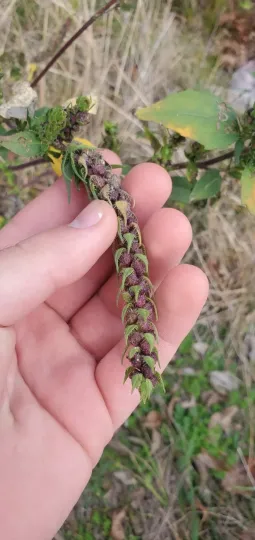
The flowers are arranged in small, inconspicuous heads located in the leaf axils, forming spike-like inflorescences. The plant is wind-pollinated and produces large quantities of pollen.
The fruit is a small, dark achene with high germination potential. These seeds can remain dormant in the soil for several years, making long-term control a significant challenge for growers.
Where it grows
Native to North America, annual marshelder has spread to various regions worldwide. It is commonly classified as an invasive or troublesome agricultural weed in many temperate zones.
The weed frequently infests cultivated fields, particularly row crops like soybeans, corn, and sunflowers, where it benefits from the disturbance and ample nutrient availability.
Annual marshelder thrives in sunny, fertile conditions and is often found along field edges, roadsides, disturbed waste areas, and in low-lying moist soils where water collects after rain.
The plant exhibits high ecological plasticity, allowing it to colonize a wide range of soil types, from sandy loams to heavy clays, provided there is sufficient light for growth.
Outbreaks are most severe in fields with poor crop rotation practices or where the soil surface remains bare for extended periods, allowing seeds to germinate without competition.
Harm it causes
The primary economic harm caused by annual marshelder is its aggressive competition with crops for essential resources such as water, sunlight, and soil nutrients, directly reducing yield.
Its rapid growth during the vegetative phase allows it to overtop and shade out crop seedlings, which limits photosynthesis and stunts the development of the primary crop.
By consuming large amounts of soil moisture through its deep taproot, annual marshelder can exacerbate the negative effects of drought on field crops, leading to significant yield loss.
Annual marshelder serves as an alternative host for various plant pathogens and viruses that can be transmitted to commercially grown crops, especially those in the sunflower family.
During harvest, the presence of these weeds increases the moisture content of the harvested product, necessitates additional drying costs, and can interfere with the efficiency of harvesting machinery.
How to control
Effective management of annual marshelder requires an integrated strategy that combines mechanical practices with chemical applications tailored to the specific crop and growth stage.
Mechanical control measures such as deep moldboard plowing help bury seeds, preventing them from germinating. Additionally, frequent inter-row cultivation is highly effective in row crops.
Optimizing planting density to ensure rapid canopy closure is a vital cultural practice, as shading the soil surface inhibits the germination and growth of new weed seedlings.
Chemical control should be implemented using selective herbicides. Applications are most effective when timed during the early growth stages of the weed before it reaches the flowering stage.
- Timely removal of seedlings to prevent seed set;
- Implementation of diversified crop rotations;
- Use of residual herbicides to manage emergence throughout the season.
Taxonomy
- Latin name
- Iva annua
- Family
- Сложноцветные (астровые)
- EPPO code
- IVAAN