

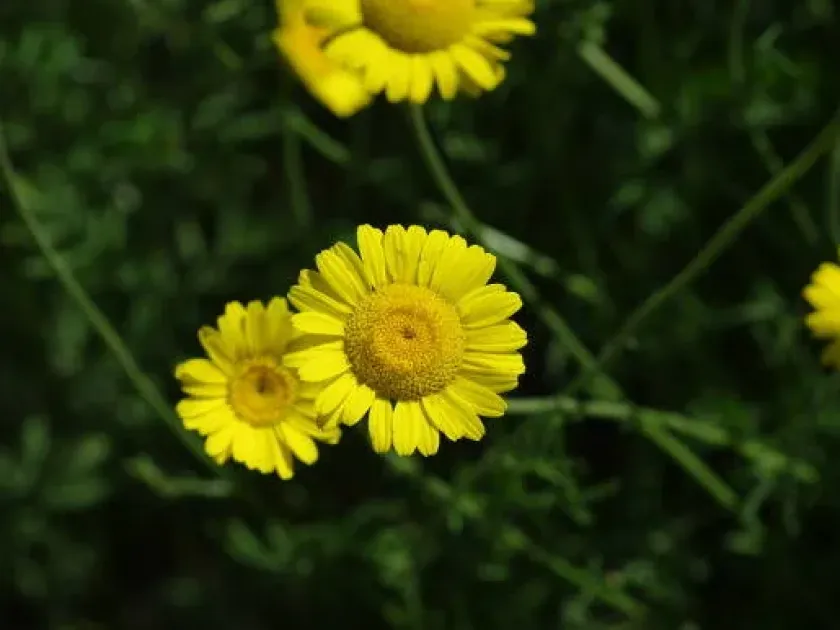
Description
How to tell it apart
Anthemis, commonly known as mayweed or chamomile-like weed, is a genus of plants belonging to the Asteraceae family. These are problematic annual or perennial weeds that frequently invade various types of agricultural crops.
The plant is characterized by finely divided, feathery leaves and daisy-like flower heads. The flowers typically feature white ray florets and yellow disk florets, which makes them look very similar to true medicinal chamomile.
Stems are usually branched and can grow up to 60 cm in height. A distinctive feature for identification is the strong, acrid, or unpleasant aroma released when the foliage is crushed or handled.
Reproduction occurs entirely through seeds, which are produced in massive quantities. A single plant can release thousands of seeds that remain viable in the soil for several years, creating a persistent seed bank.
The root system is a taproot that is highly efficient at extracting water and nutrients, allowing the weed to thrive in competitive environments and withstand periods of moisture stress.
Where it grows
Anthemis is widely distributed in arable lands, pastures, and disturbed areas. It is particularly notorious for infesting cereal crops like wheat and barley, as well as various vegetable and broad-leaved crop fields.
The weed prefers sunny, open environments and is highly adaptable to various soil types, ranging from sandy loams to heavier clays. It often colonizes roadsides, waste areas, and fallow fields, spreading seeds into neighboring crops.
It thrives in fields where crop rotation is poor or where soil management practices leave the ground exposed during the early growing season, allowing for rapid germination and establishment.
The weed is frequently introduced to new plots through contaminated agricultural machinery or the use of unclean crop seeds, which contain weed seeds that are often difficult to separate from the crop.
In high-input farming systems, it can quickly occupy the edges of fields, making it difficult to control if borders are not kept clean or if herbicide application is not uniform.
Harm it causes
The primary damage caused by Anthemis is its aggressive competition with crops for light, space, water, and essential soil nutrients. This competition significantly stunts the growth of the main crop.
Yield losses can be severe, often reaching up to 30% in heavily infested wheat or barley fields. The presence of the weed also increases the overall burden on the crop during the critical phases of development.
It acts as a host for various insects, including aphids, which can then migrate to the crop and cause further damage or spread plant viruses. This makes the weed a secondary source of pest pressure.
The presence of Anthemis seeds in harvested grain is a major quality issue. It often leads to increased costs for cleaning and drying the harvested crop to meet commercial and industrial grain standards.
During the harvest, high densities of this weed can physically obstruct machinery, slowing down harvesting operations and increasing fuel consumption and mechanical wear on combines.
How to control
Effective management requires an integrated approach. The most fundamental strategy is a diversified crop rotation that breaks the life cycle of the weed and reduces the soil seed bank over time.
Agronomic control practices, such as proper seedbed preparation and early stubble cultivation, are crucial to destroy emerging seedlings before they can establish deep roots or reach the flowering stage.
Chemical control remains the most reliable method for large-scale production. Selective herbicides, particularly those targeting broad-leaved weeds, are most effective when applied during the early rosette stage of Anthemis.
Monitoring is essential for successful timing. Once the weed enters the reproductive phase, it becomes significantly more resistant to chemical applications, and the potential for seed production increases dramatically.
- Utilize high-quality, weed-free seed for planting.
- Perform mechanical cultivation in inter-rows for row crops.
- Apply herbicides according to the specific growth stage of the weed.
- Maintain sanitation in field margins to prevent seed drift.
Content graph
Connections · Anthemis
Most often together:
Marketplace
Products · 16


Flagman
«Нанджин Ессенс Файн-Кемікал Ко. Лтд» (Китай)
Herbicides
0
0
·
1.2K
3 offers
23.17 €per 1 l
Buy


Terramidin
Nanjing No.1 Pesticide Factory of Red Sun Group Co., Ltd.
Herbicides
0
0
·
1.1K
1 offer
7.61 €per 1 l
Buy


Alpha - Brigade k.e.
F. YUNISITY ENTERPRISES LTD., United Kingdom
Herbicides
0
0
·
39
2 offers
13.93 €per 1 l
Buy


Biology
Taxonomy
- Latin name
- Anthemis
- Family
- Сложноцветные (астровые)
- EPPO code
- ANTSS